The SDO JSOC has been upgraded and some issues are keeping data from being available. While the data is being stored safely, they are not bring served to our website. The problems are being worked and should be fixed soon.

Monday, November 25, 2013
Wednesday, November 20, 2013
SDO's Comet ISON Perihelion Event Website
 |
| SDO Comet ISON viewing page |
The top bar has a couple of links and drop-down menus. You can view a movie which shows the different areas SDO will point (off-pointing- when SDO is not point directly at the sun) and explore the orbits of Comets ISON and Lovejoy (from 2011, not the current one). The 3-D interactive works with many browsers (but not Safari). It allows you to examine two sungrazing comet orbits and see the views of different satellites. Under resources are pointers to websites that discuss Comet ISON.
 |
| Three views for the perihelion of Comet ISON |
The home page will have images from four of the AIA wavelengths during each the views (off points), Approach, Perihelion, and Departure. These wavelengths were chosen because in December 2011, when Comet Lovejoy passed perihelion, it was very bright in these wavelengths, and we believe they are the best choice for Comet ISON. We will not see a normal comet tail. The glowing material is forced to move along the Sun's magnetic field. It will look like a cloud moving along and away from the orbit of the comet.
You can watch for Comet ISON using either the kiosk mode or mp4 movies. If you select "View kiosk" a new page will open and a series of images at that wavelength will be shown. As data becomes available your kiosk display will automatically add the new images. At the end of each 1-hour phase you will be looking at about 300 images. The movie will flip through all of the data and you can watch for the comet to appear. You can run/pause the display, step through the frames, and force an update. If you pause the display you can use the slider to flip back and forth in the images. New images are available in sets of 5 every minute.
If you select "Download mp4" an mp4 movie that has all of the images currently available will be sent to your machine and you can use the movie controls on your webpage to view the images. You have to re-load the mp4 every 5 minutes to get the latest data. The mp4 movies will only be updated every 5 minutes!
Join SDO and watch for Comet ISON on November 28! A great way to spend a few hours of the American Thanksgiving Day.

Tuesday, November 19, 2013
AR 11893 Waves Goodbye with an X-1 Flare

Thursday, November 14, 2013
The Perihelion Passage of Comet ISON

When they are close to the Sun, sungrazing comets can be seen in the EUV channels of SDO and other solar satellites as their debris lights up the Sun's magnetic field. As Comet ISON moves through perihelion, SDO will point at three places away from the Sun to track the comet. This figure describes what we will do.
About 100 minutes before perihelion we will point SDO at the “Approach” position. It takes about 5 minutes for SDO to point to a new place in space and allow the fuel to stop moving (“Move, settle”). We allow for that in the timing of the moves. SDO will then observe that part of space for one hour. The Sun will appear in the upper right corner of the images and Comet ISON will move through the images from the lower right to the upper left. Images should be available on the SDO Comet ISON website after 12:30 pm ET.
At 1:09 pm ET, SDO will be pointed to the “Perihelion” position and observe that part of space for an hour. This location includes the perihelion, which happens at about 1:44 pm ET. At 2:14 pm ET, SDO will point at the “Departure” and observe for another hour. We will see Comet ISON moving away from the Sun in this box. At 3:19 pm ET SDO will point back at the Sun and we will resume our solar studies.
You can also see this in a movie.
The Oort cloud is many, many comets orbiting very far from the Sun. Kind of the paint splatter from making the Solar System. We think it starts about 0.1 lightyears from the Sun and extends to 0.8 lightyears — about halfway to the next star. Comet ISON is the first Oort-cloud, sungrazing comet in quite a while. It has fallen thousands of AU to just barely miss the Sun and make its escape. Join us at the SDO Comet ISON website from 1700 to 2024 UTC (noon to 3:24 pm ET) on November 28, 2013 (Thanksgiving Day in the USA) to watch this unique event.
Wednesday, November 13, 2013
Sunrise from the Dark Side of a Sungrazing Comet
Can you ride a sungrazing comet around the Sun by staying on the dark side? Maybe not! When you get close enough sunlight reaches around the comet and lights up the dark side. How does that work?
 Here is a picture with gears the same size and a chain wrapped around them. This is the same as gears being very far apart. The chain leaves both gears at the top and bottom of each gear. The same number of teeth are used on both gears. We can think of the Sun heating the comet in a similar way when the comet is far from the Sun. Sunlight warms only one hemisphere. But what happens if you get much closer to the Sun?
 If the left gear is made much larger than the right gear we get this picture. Now the chain leaves the large gear at the arrow, far from the top and meets the small gear away from the top. More teeth are used on the large gear, but fewer on the small. This shows that light from the Sun reaches past the one hemisphere and lights up the dark side of the comet. As comet gets really close to the Sun even someone standing on the dark side will see the sunrise.
This reminds me of bicycle chains and gears. How long does a chain have to be to reach around two gears? How many teeth fit into the chain as it wraps around?


But that sunrise will not be a little Sun coming up in the East. It will look more like a total solar eclipse fading away. A bright ring will surround the edge of the comet and slowly fill your sky to the horizon as you get closer. You would be able to see the corona first, followed by the chromosphere, and finally the bright photosphere. This effect, also called the two-pulley problem, means that comets absorb sunlight over a larger area close to the Sun than they do far away. This helps them sublimate more rapidly.
Life on a sungrazing comet would sure be different!
Check out our 3-D rendering of the orbits of sungrazing Comets ISON and Lovejoy. It shows both orbits near perihelion. You can explore why different satellites see comets differently.
Wednesday, November 6, 2013
Comet ISON Off-Point Testing Today
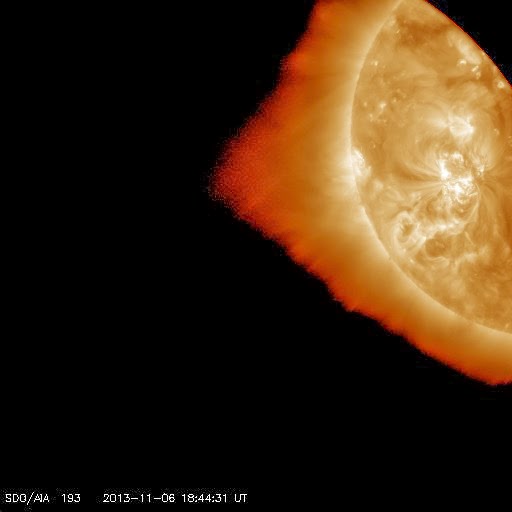
Here is an example of what the Sun will look like as Comet ISON goes through perihelion on November 28, 2013. Somewhere in the inky darkness the comet's light will be seen!
Update at 2:19 pm: Test is over and we are pointing at the Sun again.
Monday, November 4, 2013
November is Comet ISON Month for SDO

This lovely image of Comet ISON was taken on October 27, 2013 by astrophotographer Damian Peach. [Image credit: Damian Peach]
Now that November has arrived it's time to get ready for Comet C/2012 S1 (ISON). On November 28 (yes, Thanksgiving Day) at 1:45 pm ET, Comet ISON will fly only 730,000 miles above the surface of the Sun. Even though it is moving as fast as 375 km/s (840,000 mph), the Sun will heat Comet ISON, causing it to sublimate and leave a lot of water and grit behind. Comet ISON is about 2 km across, much bigger than Comet Lovejoy in December 2011, and it will leave a lot of itself behind.
Once the stuff sublimates we will watch for it to light up the corona in the AIA bandpasses. We saw Comet Lovejoy in 7 of the 10 bandpasses in December 2011. This time we will point SDO toward three different places where the comet is predicted to be. One will be centered about the time of perihelion for a half hour on each side of perihelion. The other two will point toward the paths the comet will use to approach and leave the Sun and take data for an hour at each place. The offpoints are much larger than the one we did for Comet Lovejoy in 2011. We expect that the comet debris will look a lot smoother for Comet ISON because the magnetic field that far from the surface is also smoother.
The near-realtime SDO images will be available as self-updating movies at a dedicated website that is being tested and will soon be ready. Until then, there is an ISON campaign website with a lot of good pictures and information about Comet ISON, written by people who study comets. You can also look at the Know Your Night Sky blog for observing hints, especially after perihelion as Comet ISON climbs away from the Sun towards the North Star.
During November we will talk about how much stuff we should see coming off Comet ISON, why the signatures of a sungrazing comet could be like how supernovae work, and how a belt going around two pulleys can help us to understand sungrazing comets.
Make November a month for Sun and comet watching!
Subscribe to:
Posts (Atom)