Showing posts with label SDO anniversary. Show all posts

Sunday, February 12, 2023

Happy Launch Anniversary to SDO!

SDO was launched into orbit 13 years ago yesterday, at 10:23 am ET on 11 Feb 2010. Thirteen years and millions of observations later, SDO is still producing excellent solar data. It is hard to pick out a favorite sequence of SDO data. But the Sun did provide us with a nice filament eruption a few days ago as an early anniversary present. If you look in the northern polar regions of this combined AIA 211 Å (red), 193 Å (green), and 171 Å (blue) video, you can see the dark filament rising up and breaking apart. It appears to include one of the magnetic vortices we saw in the last Solar Cycle.

These polar filaments are a key part of removing the previous cycle's magnetic field from the poles of the Sun. As Solar Cycle 25 field erupts near the equator, some of it moves towards the poles where it meets the last remaining magnetic field of Solar Cycle 24. The fields tend to have opposite directions and they form a filament where they meet. This filament will circle the pole. Some of the oddity in this movie is seeing the plasma move around the pole in both directions.

The Sun will continue to surprise us, in SDO's 13th year and probably for many years to come.

I would like to thank the people who built and launched SDO, it has been an amazing observatory. I congratulate the people who run SDO on keeping this fantastic tool on station and performing great!

SDO is GO!

Thursday, February 17, 2022

SDO 12 Years on Orbit, Large Active Region Approaching?

Last week, we celebrated the 12th anniversary of the launch of SDO. This amazing mission is still going strong, measuring the beginnings of Solar Cycle 25 with the same data stream as Solar Cycle 24. The science teams of AIA, HMI, and EVE are one part of the success of SDO. They keep the data flowing to their research, other solar scientists, and the public. Some 440 million images are now stored in the JSOC and EVE SOC!

The Flight Operations Team at Goddard Space Flight Center is another part of SDO’s success. The satellite and ground station are in great shape. FOT members help the science team by planning maneuvers to reduce the of time science data can’t be recorded. They have come to the MOC at odd hours to help resolve a problem and keep the data flowing.

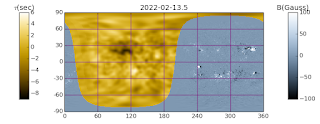
But we shouldn’t forget the final team member, the Sun. And today we can see in the far-side images from February 13, 2022, that a large active region is sitting on the far side of the Sun. We should be seeing it rotate into view about 4 days from today (7 days from February 13). There are at least 4 numbered active regions on the Sun right now. How many will be there next week?

Here is a composite far-side image showing the magnetic field of the near-side (visble disk) of the Sun in greyscale and the time shifts of the far-side in color. A large active region (or sunspot) depresses the surface of the Sun and causes the wave to re-appear earlier than average. We can see a large region on the far-side with τ about -6 seconds.

Far-side images come from analyzing the helioseismic data of HMI and similar instruments. They are useful to watch for active regions developing on the far-side of the Sun where we have little or no other information. Twelve years of HMI data have improved the far-side images, now we will benefit from that work during Solar Cycle 25.

SDO is GO!

Tuesday, February 16, 2021

Happy 11th Birthday to SDO

SDO was launched 11 years ago on February 11, 2010. It was a beautiful launch into mostly clear skies over the Kennedy Space Center in Florida. SDO has watched almost all of Solar Cycle 24, and now the beginning of Solar Cycle 25. Scientists have used SDO data to publish over 5000 papers on how the Sun works, emphasizing the creation and destruction of the solar magnetic field. Here's a movie of the Sun in AIA's 193 Å passband on February 11, 2021, showing a large filament (dark line in the southern hemisphere) just outside of a dark coronal hole. There's a bright region to the left of the filament that sits over a magnetic field concentration that never formed a sunspot. It looks like Solar Cycle 25 will be as much fun as SC 24!

Tuesday, January 19, 2021

SDO Images will be on US Stamps in June!

According to this NASA News Release, SDO images will be featured on a set of USPS First Class Forever stamps. Here's what the stamps will look like.

SDO's 100's of millions of images of the Sun’s dynamic and dazzling beauty have captivated millions of people. Near the summer solstice of 2021 you should be able to use these select 10 as beautiful stamps. Watch for them!

Friday, January 1, 2021

Welcome to 2021!

SDO was recently told we were renewed for another three years of operations. This will take us well into the rising phase of Solar Cycle 25. I would like to thank all of the people who helped write the Senior Review proposal to keep SDO operating.

Here is a excellent example of the beginning of Solar Cycle 25. This AIA 193 Å movie shows a solar disk with coronal holes, filaments, and a lovely coronal cavity above the limb at 7 o'clock. You can see the filament as the dark lines betwee the cavity and the surface. We should see more cavitites as the polar crown filament continues to form.

Have a prosperous 2021!

Tuesday, February 11, 2020

Happy Anniversary SDO!

Ten years ago, 11 Feb 2010, SDO rose majestically into the Florida skies. Since that day we have taken and recorded over 350 million images of the Sun.
Here's the image closest to the launch time, a lovely 211 Å image showing a large coronal hole over the South Pole and a smaller one over the north. Pretty typical solar minimum portrait!

Over the next year, Solar Cycle 25 will become more and more apparent. SDO will be there, observing the Sun and its magnetic field.

Congratulations to the SDO teams and all the people who enjoy our data!

Sunday, November 17, 2019

200 Millionth Image from AIA

In all the hype about the Mercury transit last Monday, we overlooked another milestone in the SDO mission. On November 5, 2019, the AIA instrument returned its 200 millionth image. Here it is and it's a beauty in the AIA 171 Å passband!
The Sun looks like it is in solar minimum, with large polar coronal holes over the North and South poles. Hope for the future can be seen in the area with the black line drawn around it. That's active region 12750, a small bi-polar region that has the polarity of Solar Cycle 25 and an appropriately high latitude of 28°S. Other SC25 regions have been seen and they will become more frequent as SC25 starts its rise to maximum.


Mark Cheung, PI of AIA, made a movie to celebrate this milestone.

Congratulations to the AIA team for building a robust instrument that has returned excellent data for almost 10 years.