Wednesday, June 23, 2010

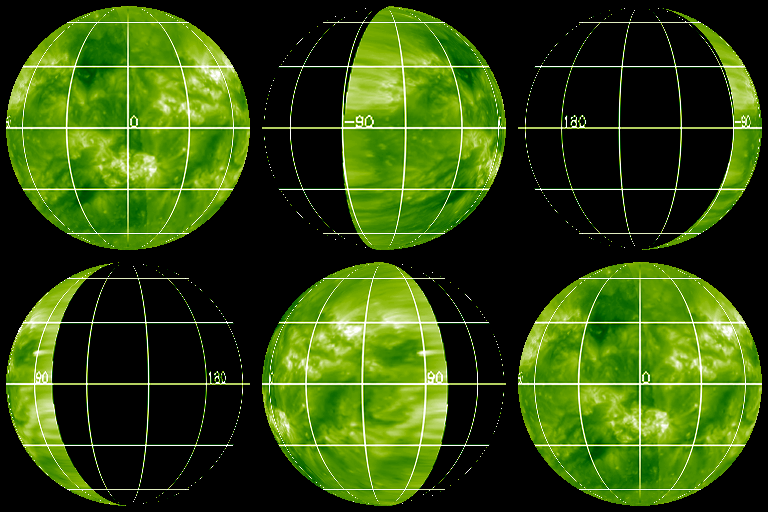
STEREO 3D Sun maps now using SDO data


As the two STEREO spacecraft continue their journey along Earth's orbital path, one 70 degrees ahead of Earth and one 70 degrees behind, they have reached the point where they can almost see the Sun on the opposite side of Earth.  The maps and movies are now using SDO data to complete the picture.  http://stereo-ssc.nascom.nasa.gov/beacon/beacon_secchi.shtml

Tuesday, June 22, 2010

EVE Data Release

The Version 1 official calibrated products are now available effective June 18, 2010. We currently support only expert access directly to the files. A graphical tool that supports searching will soon be available. EVE has been making solar measurements since March 26, 2010. Normal operations began on May 1, 2010.


Level 1 Product Overview:


The ESP Level 1 irradiance data are fully calibrated and corrected for particle background, visible light leakage, degradation in sensitivity, and spacecraft location (corrected to 1‐AU).

A suborbital sounding rocket payload is flown once a year for EVE absolute calibrations. The first suborbital flight after the launch of SDO was on May 3, 2010. Daily on‐orbit calibrations are performed to track changes in detector dark current, filter condition, and electrometer gain.

Each data file covers a time span of 24 hours with 4 measurement/sec cadence. Level 1 data is available with 1 day latency.


Level 2 Product Overview:


There are 2 types of EVE level 2 products: Spectra (EVS) and Lines (EVL). Level 2 spectra are the merged spectral measurements from the two spectrographs, A and B. The A detector is designed to measure from 6‐17 nm, and 16‐38 nm using two filters, while the B detector is designed to measure 35‐105 nm. Level 2 processing stitches these pieces to form one spectrum.

Lines are integrated from low to high bounds, and the 4 Hz photometer data are averaged down to the same time scale as the spectrum. No continuum is subtracted from the line irradiances.


Links


Thursday, June 3, 2010

Try Our New Data Browser

We have started a beta version of an SDO movie browser. It allows you to look at movies and still images of the AIA 15-minute cadence data since May 26, 2010.

We have released the SDO data browser. It allows you to look at movies and still images of the AIA 15-minute cadence data since May 20, 2010.

The features include:

  • still images

  • movies (as a slide show)

  • zip archive download


The web address is: http://sdo.gsfc.nasa.gov/data/aiahmi/browse.php

Tuesday, May 25, 2010

Spacecraft Reveals Small Solar Events Have Large Scale Effects

NASA's Solar Dynamics Observatory, or SDO, has allowed scientists for the first time to comprehensively view the dynamic nature of storms on the sun. Solar storms have been recognized as a cause of technological problems on Earth since the invention of the telegraph in the 19th century.

The Atmospheric Imaging Assembly (AIA), one of three instruments aboard SDO, allowed scientists to discover that even minor solar events are never truly small scale. Shortly after AIA opened its doors on March 30, scientists observed a large eruptive prominence on the sun's edge, followed by a filament eruption a third of the way across the star's disk from the eruption.

"Even small events restructure large regions of the solar surface," said Alan Title, AIA principal investigator at Lockheed Martin Advanced Technology Center in Palo Alto, Calif. "It's been possible to recognize the size of these regions because of the combination of spatial, temporal and area coverage provided by AIA."

read more...

» SDO AAS Press Briefing Materials


Monday, May 24, 2010

SDO is the Astronomy Picture of the Day - May 22, 2010


Dark Filament of the Sun


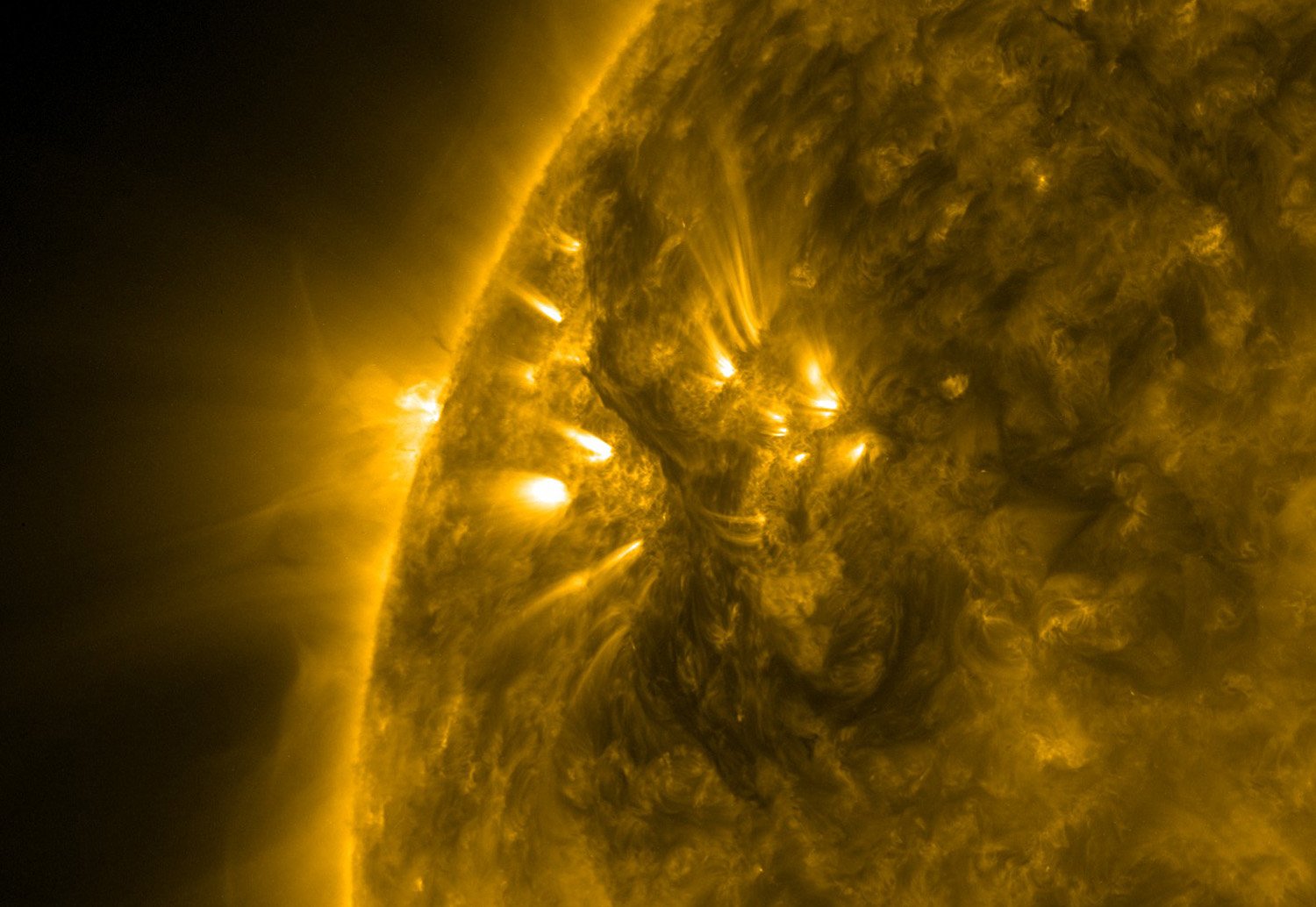
Explanation: Suspended by magnetic fields above a solar active region this dark filament stretches over 40 earth-diameters. The ominous structure appears to be frozen in time near the Sun's edge, but solar filaments are unstable and often erupt. The detailed scene was captured on May 18 in extreme ultraviolet light by cameras on board the Solar Dynamics Observatory. While the cooler plasma of the filament looks dark, hotter, brighter plasma below traces magnetic field lines emerging from the active region. When seen arcing above the edge of the Sun, filaments actually look bright against the dark background of space and are called prominences.


Credit: NASA / Goddard / SDO AIA Team
APOD Website

Friday, May 21, 2010

A new media piece featuring SDO

KQED, Northern California Public Broadcasting (NCPB), has produced a very good piece on SDO titled, "Journey to the Sun"


Video Summary:


Scientists at Stanford University and Lockheed Martin are playing pivotal roles in a nearly billion-dollar NASA mission to explore the sun. A spacecraft launched in early 2010 is obtaining IMAX-like images of the sun every second of the day, generating more data than any NASA mission in history.


Monday, May 10, 2010

SDO Day 89: Our Next Poem


We have had haikus and sonnets written about the commissioning phase. Now a First Light poem, written by Stuart Atkinson about the prominence eruption on March 30, 2010.


First Light...
And at last, the secret of our solar system's star has been revealed:
Concealed beneath its brightly shimmering, ever-shifting shells
Of ancient hydrogen a mighty dragon lies; planet-sized
Eyes flashing with photon fire, riding the great plasma tides
Boiling up from Sol's deep core, it roars in raw delight,
Feeding on the brutal fusion light throbbing beneath its feet...
Hiding in the Sun's dark heart it bathes in nuclear fire,
Revelling in its fury, rolling in it, each beat of its wings
Sending great waves of energy slamming up into the
Chromosphere to ripple and roil across Sol's surface
In tsunamis of atomic fire, to the amazement of those watching,
Wide-eyed, on Faraday's far-away Earth...
But these images reveal the dragon is not alone;
The Sun's firestorm fields clearly have shielded
Our prying eyes from flocks of phoenixes flying
In the dragon's wake. Each time a starfirebird bursts
Through the seething surface of our star we see
A glorious prominence leaping into space;
Every feathered, towering arch traces out the path
Of a phoenix's graceful rise and fall.
Each time one manages to break free
Of the Sun's greedy gravity we see a
Fiery red banner billow out, tatter and tear,
Flapping away like it had never been there...
© Stuart Atkinson 2010