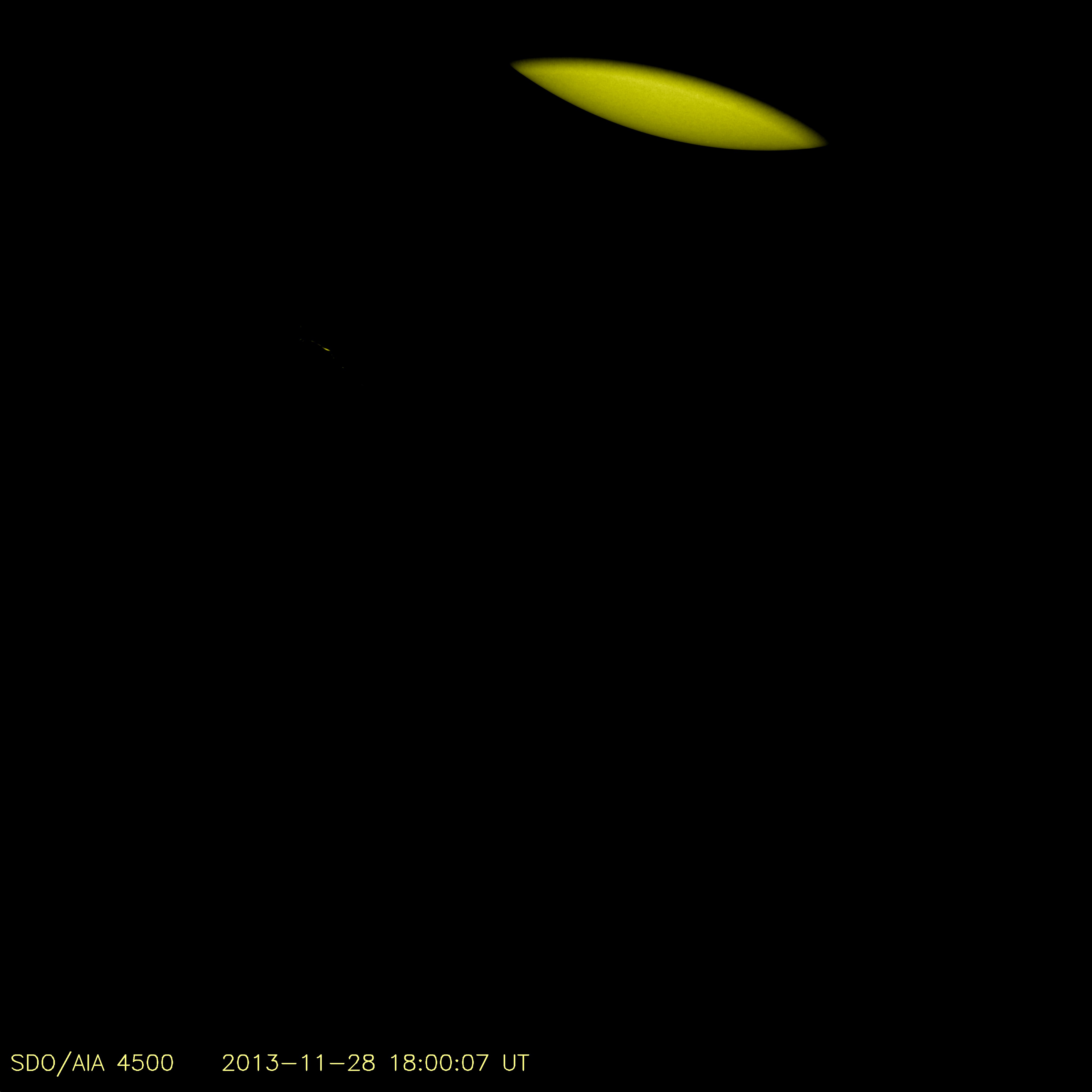
This test assures that the SDO Team will be able to point SDO at an incoming comet with a 24-48 hour notice from the Sungrazer Comet Watchers.

Showing posts with label SDO comets. Show all posts
Showing posts with label SDO comets. Show all posts
Thursday, August 25, 2022
Comet Off-Point Test Today
Although a comet hasn't been seen in the SDO field of view since 2012, we are always waiting for the next comet to appear. Today we will run our comet off-point test to make sure we are ready for the rapid response that is necessary. Starting at 1800 UTC (2:00 pm ET) SDO will point up and to the left of the Sun's center for 15 minutes. We will then return to solar-center pointing and hold in inertial mode for 15 minutes, allowing the attitude control engineers to run further tests. By 1850 UTC (2:50 pm ET) SDO will return to normal science mode.

Monday, December 30, 2013
Was Comet ISON Seen in AIA 4500?

The AIA 4500 image described in the blog is shown on the left. An arrow points to a bright area that is claimed to be fragments of Comet ISON breaking up near perihelion. A large format version is available from our jpeg archive on the SDO website.
This bright area is an artifact resulting from stray light entering the telescope through a pinhole leak in one of the front filters. Our science data files are available from the SDO JSOC as fits (Flexible Image Transport System) files, the astronomy way to store image data. Each CCD image moves through a series of image processing to subtract the bias field, correct for dark current, subtract the flat field, remove proton hits, and other known effects. The final science data is the processed image. You need special software to work with fits files, so we convert the images to jpeg files to make them easier for a larger audience to use.


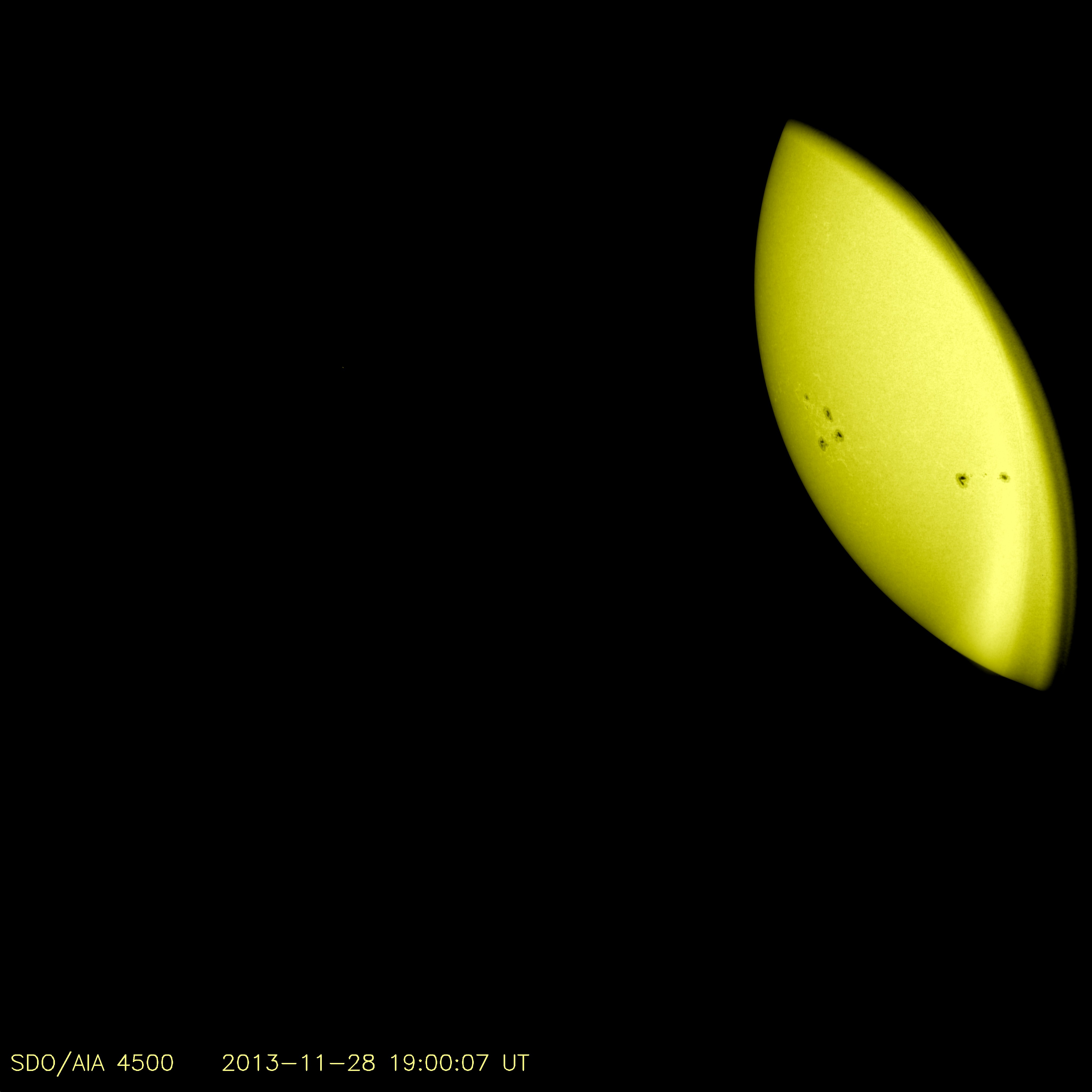
SDO Science Team members were very disappointed to not see Comet ISON as it flew by the Sun. We are convinced that SDO data does not reveal the presence of the cometary detritus.
Thursday, November 28, 2013
Comet ISON Looking Good for Perihelion Passage, 30 minutes and we start looking!


Wednesday, November 20, 2013
SDO's Comet ISON Perihelion Event Website
 |
| SDO Comet ISON viewing page |
The top bar has a couple of links and drop-down menus. You can view a movie which shows the different areas SDO will point (off-pointing- when SDO is not point directly at the sun) and explore the orbits of Comets ISON and Lovejoy (from 2011, not the current one). The 3-D interactive works with many browsers (but not Safari). It allows you to examine two sungrazing comet orbits and see the views of different satellites. Under resources are pointers to websites that discuss Comet ISON.
 |
| Three views for the perihelion of Comet ISON |
The home page will have images from four of the AIA wavelengths during each the views (off points), Approach, Perihelion, and Departure. These wavelengths were chosen because in December 2011, when Comet Lovejoy passed perihelion, it was very bright in these wavelengths, and we believe they are the best choice for Comet ISON. We will not see a normal comet tail. The glowing material is forced to move along the Sun's magnetic field. It will look like a cloud moving along and away from the orbit of the comet.
You can watch for Comet ISON using either the kiosk mode or mp4 movies. If you select "View kiosk" a new page will open and a series of images at that wavelength will be shown. As data becomes available your kiosk display will automatically add the new images. At the end of each 1-hour phase you will be looking at about 300 images. The movie will flip through all of the data and you can watch for the comet to appear. You can run/pause the display, step through the frames, and force an update. If you pause the display you can use the slider to flip back and forth in the images. New images are available in sets of 5 every minute.
If you select "Download mp4" an mp4 movie that has all of the images currently available will be sent to your machine and you can use the movie controls on your webpage to view the images. You have to re-load the mp4 every 5 minutes to get the latest data. The mp4 movies will only be updated every 5 minutes!
Join SDO and watch for Comet ISON on November 28! A great way to spend a few hours of the American Thanksgiving Day.
Thursday, November 14, 2013
The Perihelion Passage of Comet ISON

When they are close to the Sun, sungrazing comets can be seen in the EUV channels of SDO and other solar satellites as their debris lights up the Sun's magnetic field. As Comet ISON moves through perihelion, SDO will point at three places away from the Sun to track the comet. This figure describes what we will do.
About 100 minutes before perihelion we will point SDO at the “Approach” position. It takes about 5 minutes for SDO to point to a new place in space and allow the fuel to stop moving (“Move, settle”). We allow for that in the timing of the moves. SDO will then observe that part of space for one hour. The Sun will appear in the upper right corner of the images and Comet ISON will move through the images from the lower right to the upper left. Images should be available on the SDO Comet ISON website after 12:30 pm ET.
At 1:09 pm ET, SDO will be pointed to the “Perihelion” position and observe that part of space for an hour. This location includes the perihelion, which happens at about 1:44 pm ET. At 2:14 pm ET, SDO will point at the “Departure” and observe for another hour. We will see Comet ISON moving away from the Sun in this box. At 3:19 pm ET SDO will point back at the Sun and we will resume our solar studies.
You can also see this in a movie.
The Oort cloud is many, many comets orbiting very far from the Sun. Kind of the paint splatter from making the Solar System. We think it starts about 0.1 lightyears from the Sun and extends to 0.8 lightyears — about halfway to the next star. Comet ISON is the first Oort-cloud, sungrazing comet in quite a while. It has fallen thousands of AU to just barely miss the Sun and make its escape. Join us at the SDO Comet ISON website from 1700 to 2024 UTC (noon to 3:24 pm ET) on November 28, 2013 (Thanksgiving Day in the USA) to watch this unique event.
Wednesday, November 13, 2013
Sunrise from the Dark Side of a Sungrazing Comet
Can you ride a sungrazing comet around the Sun by staying on the dark side? Maybe not! When you get close enough sunlight reaches around the comet and lights up the dark side. How does that work?
 Here is a picture with gears the same size and a chain wrapped around them. This is the same as gears being very far apart. The chain leaves both gears at the top and bottom of each gear. The same number of teeth are used on both gears. We can think of the Sun heating the comet in a similar way when the comet is far from the Sun. Sunlight warms only one hemisphere. But what happens if you get much closer to the Sun?
 If the left gear is made much larger than the right gear we get this picture. Now the chain leaves the large gear at the arrow, far from the top and meets the small gear away from the top. More teeth are used on the large gear, but fewer on the small. This shows that light from the Sun reaches past the one hemisphere and lights up the dark side of the comet. As comet gets really close to the Sun even someone standing on the dark side will see the sunrise.
This reminds me of bicycle chains and gears. How long does a chain have to be to reach around two gears? How many teeth fit into the chain as it wraps around?


But that sunrise will not be a little Sun coming up in the East. It will look more like a total solar eclipse fading away. A bright ring will surround the edge of the comet and slowly fill your sky to the horizon as you get closer. You would be able to see the corona first, followed by the chromosphere, and finally the bright photosphere. This effect, also called the two-pulley problem, means that comets absorb sunlight over a larger area close to the Sun than they do far away. This helps them sublimate more rapidly.
Life on a sungrazing comet would sure be different!
Check out our 3-D rendering of the orbits of sungrazing Comets ISON and Lovejoy. It shows both orbits near perihelion. You can explore why different satellites see comets differently.
Wednesday, November 6, 2013
Comet ISON Off-Point Testing Today
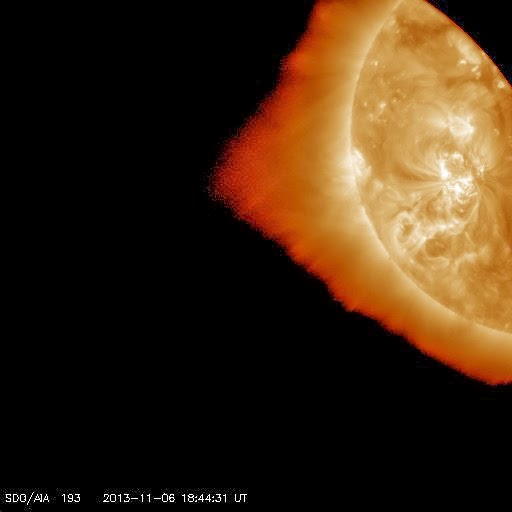
Here is an example of what the Sun will look like as Comet ISON goes through perihelion on November 28, 2013. Somewhere in the inky darkness the comet's light will be seen!
Update at 2:19 pm: Test is over and we are pointing at the Sun again.
Monday, November 4, 2013
November is Comet ISON Month for SDO

This lovely image of Comet ISON was taken on October 27, 2013 by astrophotographer Damian Peach. [Image credit: Damian Peach]
Now that November has arrived it's time to get ready for Comet C/2012 S1 (ISON). On November 28 (yes, Thanksgiving Day) at 1:45 pm ET, Comet ISON will fly only 730,000 miles above the surface of the Sun. Even though it is moving as fast as 375 km/s (840,000 mph), the Sun will heat Comet ISON, causing it to sublimate and leave a lot of water and grit behind. Comet ISON is about 2 km across, much bigger than Comet Lovejoy in December 2011, and it will leave a lot of itself behind.
Once the stuff sublimates we will watch for it to light up the corona in the AIA bandpasses. We saw Comet Lovejoy in 7 of the 10 bandpasses in December 2011. This time we will point SDO toward three different places where the comet is predicted to be. One will be centered about the time of perihelion for a half hour on each side of perihelion. The other two will point toward the paths the comet will use to approach and leave the Sun and take data for an hour at each place. The offpoints are much larger than the one we did for Comet Lovejoy in 2011. We expect that the comet debris will look a lot smoother for Comet ISON because the magnetic field that far from the surface is also smoother.
The near-realtime SDO images will be available as self-updating movies at a dedicated website that is being tested and will soon be ready. Until then, there is an ISON campaign website with a lot of good pictures and information about Comet ISON, written by people who study comets. You can also look at the Know Your Night Sky blog for observing hints, especially after perihelion as Comet ISON climbs away from the Sun towards the North Star.
During November we will talk about how much stuff we should see coming off Comet ISON, why the signatures of a sungrazing comet could be like how supernovae work, and how a belt going around two pulleys can help us to understand sungrazing comets.
Make November a month for Sun and comet watching!
Wednesday, August 7, 2013
The Perihelion Passage of Comet ISON

Comet ISON is a sungrazing comet whose closest approach to the Sun (perihelion) will happen on November 28, 2013. Comet ISON was discovered last year by two Russian observers when it was further from the Sun than Jupiter. This usually means the comet is large and will become bright. Comet ISON's nucleus is thought to be about 2 miles across (no more than 4 km from HST observations). It is currently approaching the frost line at 2-3 AU where water ice will start to evaporate and the comet will brighten. We had a Comet ISON workshop last week at APL in Maryland. You can go to that site for information about Comet ISON and the many ways people will be observing it.
Comet ISON may become a spectacular comet in the night sky but SDO cannot see a comet until it is passing very close to the Sun. This graphic was developed to show what we learn from Comet ISON that is different from the previous comets that were seen by the EUV telescopes on SDO and STEREO.
The numbers on the left are the distances from the center of the Sun, with curves drawn at each integer distance from 1-4 solar radii (1-4 Rsun).
Next are the perihelion distances of the two sungrazing comets seen in the EUV and Comet ISON, also extended as curves across the diagram. Sungrazing comets do not dive into the Sun, they appear to skim along the surface of the Sun. That allows for a lot of heating from the hot Sun but also means they don't burn up from friction like a meteor in the Earth's atmosphere. Many things change as you adjust the perihelion distance. For example, Comet Lovejoy was moving at 575 km/s (1.3 million mph) at a perihelion distance of 1.15 Rsun. Comet ISON will be sailing along at a mere 375 km/s (840,000 mph) at its perihelion. Comet Lovejoy took about 1 hour to go last part of its orbit (from 2.3 Rsun to 1.15 Rsun). Comet ISON will take over 3 hours to do the same, but this time moving from 5.4 Rsun to 2.7 Rsun.
"Breaking Up" shows the locations of the Roche limits for fluid and solid spheres. If a fluid ball flies closer to the Sun then the top of this bar it will break up into fragments, if a solid ball flies closer than the bottom of the bar it will break up. The first two comets were likely to fall apart because they flew so close, well below the Roche limit for a solid ball, but Comet ISON will fly through a region where it may or may not break up.
"Ice Evaporation" is an indication of the heating by solar radiation compared to the heating at the photosphere (or 1 Rsun). The heating of the comet by the Sun increases as the comet gets closer to the surface, but another effect that I call the two-pulley problem increases the heating even more. The first is the proximity effect but the second only happens when a small body gets close to a large body. More than half of the small body gets heated at once. That means the heating rate at 4 Rsun is 30 times less than the rate at the Sun's surface rather then the 16 ([1/4]4) times less you would think from the proximity effect alone. For comparison, the heating rate at the Earth is 50000 times smaller than the heating just above the surface of the Sun!
"Melting Sand" shows the region below 4 Rsun where micrometeoroids about 1 micron in size rapidly evaporate. Micrometeoroids are small sand particles in the comet ice. As the ice evaporates the particles are released and they also evaporate as they are heated by the Sun. The location of this boundary varies a great deal with the model of the micrometeoroid and will be tested by ISON where it leaves the material behind.
The "Visibility" grey bar, is the focus of our work on ISON into what makes the comet debris bright in the EUV. It is our primary known unknown at this time.
The "Escape" bar shows the solar wind acceleration region extending from 1.1 to above 4 Rsun. Debris from Comet ISON may be swept out into the heliosphere by the same acceleration that removes the solar wind from the Sun. Observations of Comet ISON may allow us to watch this happen. A lot of debris from the earlier two comets was left in the coronal loops and will slowly become part of the solar wind.
The coronal loops and helmet streamers show the types of magnetic fields the comets will fly through. At Comet ISON the magnetic field is mostly up and down, only the helmet streamers stick up this high in the corona. Closer to the Sun the field forms coronal loops and the debris is trapped near the surface. This is why we saw the tail of Comet Lovejoy wiggling. The tail of Comet ISON will probably look like swaying stalks as it will leave debris in a much simpler magnetic field.
Have a comet for Thanksgiving!
Friday, June 7, 2013
Comet Lovejoy, from SDO to Science and the BBC
The perihelion passage of Comet Lovejoy is described in an article at the BBC. The research article, by Cooper Downs and Karel Schrijver and others, shows how the comet's tail reacts to the coronal magnetic field as it moves along that field. That article appears in Science magazine. Sun-grazing comets that can be seen in the EUV give us a new window on the world of the corona. It is a shame they are rare, but Comet ISON may be a good show this Thanksgiving Day.
Dr. Downs was interviewed on today's episode of Science Friday. It sounded good and a video of Comet Lovejoy is also posted on the site.
Wednesday, March 13, 2013
Comets and YouTube

So go out and look for a comet near the Sun. It will be good practice for finding Comet ISON when it goes around the Sun in November, maybe close enough to be seen by SDO.
SDO is featured in a YouTube video on Coronal Rain by SciShow. Check it Out!
Monday, December 17, 2012
One Year Since Comet Lovejoy's Perihelion

In the past year we have figured out one way the comet tail can be bright in the solar corona. (Check out the paper at the Physics ArXiv site.) But we still don't know how the solar magnetic field affects (and is affected by) the comet as it moves through. All of that stuff coming off the comet makes the field shake, can we learn something from that? The brightness of the comet debris comes from running into electrons in the corona. Can we learn about the number of electrons in the corona?
We need even bigger sun-grazing comets!
Since Comet Lovejoy we have had only one alert to look for a comet in SDO and we saw nothing. But Comet ISON is due on Thanksgiving Day next year. It was acquired out near Jupiter, which usually means it is a big comet. As it moves toward the Sun, people are watching to see if stays bright. If it does we will be in for quite a show. Comet Lovejoy came in from the south and was seen only in the southern hemisphere. Comet ISON is coming in from the north and could be visible from the United States both inbound and outbound. Comet ISON will also pass through the corona a little farther out than did Comet Lovejoy, 1.2 million km (1.9 million miles) above the Sun's surface.
It would be like fireworks on Thanksgiving!
Wednesday, September 26, 2012
Website is Back, New Sun-Grazing Comet Seen Near Jupiter
The SDO website has returned to service.
A Russian observatory is announcing the discovery of the a new sun-grazing comet, this time out near Jupiter. Comet C/2012 S1 (ISON) will approach close to the Sun in November 2013, possibly as close as 0.012 AU (about 2 Rsun above the surface). It may become visible to the naked eye as well.
Comets become visible because they outgas water and other molecules, which reflect sunlight. The further from the Sun the comet becomes visible the bigger the comet usually is. Let's hope that we can get some nice data from SDO during the perihelion passage of Comet C/2012 S1 (ISON).
Tuesday, March 13, 2012
Another Comet?
SOHO and STEREO are reporting another Kruetz comet moving toward the Sun. It is expected to make its closest approach to the Sun tomorrow, March 14. If it survives perihelion and is bright enough, we would see this comet appearing in the upper right side of the Sun and moving down over the disk. Current estimates are that this comet is smaller than Lovejoy. At this time we do not know the time of perihelion passage.
We have a daily eclipse of the Sun by the Earth (at 0630-0730 UTC tomorrow), and a momentum management burn tomorrow at from 1845-1915 UTC. During both periods the images of the Sun may be absent.
We have a daily eclipse of the Sun by the Earth (at 0630-0730 UTC tomorrow), and a momentum management burn tomorrow at from 1845-1915 UTC. During both periods the images of the Sun may be absent.
Thursday, December 15, 2011
SDO and Comet Lovejoy
Out out 171 and 193 as your first attempts. We see the the comet in 171 at 23:58:59! At 23:59:18 in 193!
The AIA team has reported seeing Comet Lovejoy coming out from behind the Sun after perihelion at about 00:41.
The AIA team has reported seeing Comet Lovejoy coming out from behind the Sun after perihelion at about 00:41.
SDO and Comet Lovejoy
SDO has completed the off-point maneuver and is sending the images to the ground. They should be moving thru the pipeline and available in 30 minutes at http://sdo.gsfc.nasa.gov/data/lovejoy.php
SDO and Comet Lovejoy

SoHo and STEREO continue to watch Comet Lovejoy as it moves closer to the Sun and brightens. We will be running a special mode this evening to look for the Sun in the SDO instruments.
To the left is a still showing the comet headed towards the Sun. Below is a great movie from the
LASCO C3 coronagraph
showing how bright the comet is earlier today.
Wednesday, December 14, 2011
Will SDO see another comet?
We are setting up a special website to watch Comet Lovejoy pass by the Sun tomorrow night. The URL will be published tomorrow afternoon. You will be able to examine the special off-point images for signatures of the comet! The Helioviewer website is also available for making movies and looking for the comet.
Comet Lovejoy was discovered on November 27, 2011. It is a Kreutz comet, one of a family of comets that move along the same orbit---much like the meteoroids in a meteor shower. These comets come so close to the Sun that they are called sun-grazing comets.
Comet Lovejoy may become one of the brightest Kreutz comets ever seen. The latest estimates are a visible magnitude of -3. (Bright stars are magnitude -1 or dimmer.) We are making special efforts to see Comet Lovejoy this week.

Thursday night at 7:30 pm ET Comet Lovejoy will move through its closest approach to the Sun. Starting at 23:30 UTC (6:30 pm ET) Thursday we will point the SDO spacecraft a little to the left of its usual position. The images will look like this figure, where the circle is the edge of the Sun and the X’s are where we estimate the comet will be and the red arrow shows the direction the comet moves. Watching from SDO the comet goes behind at 00:22 UTC (7:22 pm ET).
All three instruments on SDO will be watching the comet. The EUV images from AIA would show the second comet seen in these ultraviolet wavelengths (the first was in July). HMI and AIA can use the comet to understand the roll of the spacecraft. EVE might see some of the atomic ions responsible for making the comet bright in the EUV.

In July we saw a Kreutz comet disappear as it passed across the face of the Sun, why does it go behind the Sun this time?
The way we see a Kruetz comet depends on where we look from. We have constructed a 3-D model of the comet orbit from blue wire and a yellow sphere. The top picture shows how the comet will move Thursday night; up from below the ecliptic, behind the Sun, and then back down, generally moving from left to right.

A view from the July position of the Earth is shown in the lower picture. The comet seen then moved up and across the face of the Sun (from right to left) because the Earth and SDO were on the other side of our orbit.
Amazing fact #1: A Kreutz comet takes 800-900 years to orbit the Sun. Because its closest approach (or perihelion) is only 0.2 solar radii above the Sun’s photosphere, each comet must travel 150-200 AU (out near Sedna) out into space before returning!
Amazing fact #2: No Kreutz comet seen by SoHO has survived perihelion passage. The comets go behind the occulting disk and do not re-appear. They probably evaporate in the fierce heat of the Sun.
Amazing fact #3: SDO is not the only satellite that will be watching Comet Lovejoy. Coronagraphs on STEREO and SOHO are already seeing the comet move toward the Sun.
It should a great show!
Subscribe to:
Posts (Atom)