Wednesday, September 23, 2009

EVE: Measuring the Sun's Hidden Variability

Every 11 years, the sun undergoes a furious upheaval. Dark sunspots burst forth from beneath the sun's surface. Explosions as powerful as a billion atomic bombs spark intense flares of high-energy radiation. Clouds of gas big enough to swallow planets break away and billow into space. It's a flamboyant display of stellar power.

So why can't we see any of it?

Almost none of the drama of Solar Maximum is visible to the human eye. Look at the sun in the noontime sky and—ho-hum—it's the same old bland ball of light.

"The problem is, human eyes are tuned to the wrong wavelength," explains Tom Woods, a solar physicist at the University of Colorado in Boulder. "If you want to get a good look at solar activity, you need to look in the EUV."

EUV is short for "extreme ultraviolet," a high-energy form of ultraviolet radiation with wavelengths between 1 and 120 nanometers. EUV photons are much more energetic and dangerous than the ordinary UV rays that cause sunburns. Fortunately for humans, Earth's atmosphere blocks solar EUV; otherwise a day at the beach could be fatal.

When the sun is active, solar EUV emissions can rise and fall by factors of hundreds to thousands in just a matter of minutes. These surges heat Earth's upper atmosphere, puffing it up and increasing the air friction, or "drag," on satellites. EUV photons also break apart atoms and molecules, creating a layer of ions in the upper atmosphere that can severely disturb radio signals.

To monitor these energetic photons, NASA is going to launch a sensor named "EVE," short for EUV Variability Experiment, onboard the Solar Dynamics Observatory this winter.

"EVE gives us the highest time resolution and the highest spectral resolution that we've ever had for measuring the sun, and we'll have it 24/7," says Woods, the lead scientist for EVE. "This is a huge improvement over past missions."

Although EVE is designed to study solar activity, its first order of business is to study solar inactivity. SDO is going to launch during the deepest solar minimum in almost 100 years. Sunspots, flares and CMEs are at a low ebb. That's okay with Woods. He considers solar minimum just as interesting as solar maximum.

"Solar minimum is a quiet time when we can establish a baseline for evaluating long-term trends," he explains. "All stars are variable at some level, and the sun is no exception. We want to compare the sun's brightness now to its brightness during previous minima and ask: is the sun getting brighter or dimmer?"

The answer seems to be dimmer. Measurements by a variety of spacecraft indicate a 12-year lessening of the sun's "irradiance" by about 0.02% at visible wavelengths and 6% at EUV wavelengths. These results, which compare the solar minimum of 2008-09 to the previous minimum of 1996, are still very preliminary. EVE will improve confidence in the trend by pinning down the EUV spectrum with unprecedented accuracy.

The sun's variability and its potential for future changes are not fully understood—hence the need for EVE. "The EUV portion of the sun's spectrum is what changes most during a solar cycle," says Woods, "and that is the part of the spectrum we will be observing."

Woods gazes out his office window at the Colorado sun. It looks the same as usual. EVE, he knows, will have a different story to tell.

Monday, August 24, 2009

What Lies inside the Sun?

When a pond's surface is calm, you can see more clearly into its depths. As it turns out, the same is true for the sun.

Researchers are excited that the sun's surface is calmer now than it's been in almost a century. It's a rare opportunity — the first since the Space Age began — to peer more clearly into the sun's mysterious interior.

To take advantage of the opportunity, NASA is about to launch the Solar Dynamics Observatory (SDO). SDO is expected to launch this year, as early as November 2009.

"That's perfect timing," says Dean Pesnell, a solar physicist at the Goddard Space Flight Center in Greenbelt, Md. "The sun is experiencing a century-class solar minimum, offering the clearest possible views."

"SDO will actually see through the sun's surface," added Pesnell. "The process is a little like taking an ultrasound of a pregnant mother. You can see the baby right through the skin."

The sensor that performs this trick is called the Helioseismic and Magnetic Imager (HMI). It can sense acoustic waves moving through the sun, and turn those waves into a fairly clear image of the interior.

"There's a lot going on inside the sun that we don't understand," notes Todd Hoeksema, a solar physicist at Stanford University, Palo Alto, Calif. where the HMI was built. "The Solar Dynamics Observatory is bound to deliver some big discoveries."

The biggest discovery of all would be the inner workings of the solar dynamo. Deep beneath the sun's visible surface, massive currents of electrically-charged gas (plasma) circulate in patterns that give rise to the sun's powerful magnetic field. Almost all solar activity from sunspots to solar flares is regulated by this inner dynamo.

"Understanding how the dynamo works is a holy grail for stellar physics," says Pesnell. "It is the key to forecasting solar activity and space weather."

The problem is these deep flows are hidden from view. The sun's surface is bright and opaque, so it is impossible to look through it. Instead, solar physicists study the sun's interior the same way that geologists look deep into the Earth—via seismology. Just as earthquakes trigger seismic waves that travel through the Earth, shifting mass in the sun sends pressure waves rippling through its interior. These p modes (p for pressure) bounce around inside the sun, causing the star to ring like an enormous bell. HMI detects the surface vibrations, which in turn can be analyzed to reveal the depths.

Sunspots can get in the way of the waves, distorting their times and frequencies, making it tricky to figure out what's really happening inside the complicated solar interior. That's why the current lack of sunspots is good for helioseismology.

"You have more sensitivity to what's happening deep in the sun when there's not as much interference from the surface," Hoeksema explains. At the peak of the solar cycle, sunspots are numerous. So far in 2009, the sun's surface has been free of sunspots about 80 percent of the time — the most tranquil it's been since 1913.

From a geosynchronous orbit 22,000 miles above Earth's surface, SDO will observe helioseismic waves more precisely than ever before. The current gold standard for observing the sun is a satellite called the Solar and Heliospheric Observatory, or SOHO, which maps helioseismic activity with mega-pixel resolution once every minute or so. HMI will up the ante to 16 megapixels every 45 seconds, resulting in a far more detailed view of the solar interior.

SDO will also improve on SOHO by beaming its torrent of raw data down to Earth unprocessed. Because of limited download bandwidth, SOHO performs some calculations while the data are still onboard the spacecraft. Only the results are beamed to scientists. Since SOHO was launched in 1995, scientists have since devised better ways to process the data and correct for errors. But there's no way they can apply these new techniques to SOHO imagery because the data have already been "crunched" by the time they leave the spacecraft.

To give scientists full access to its original data, SDO will have a continuous, 150 megabit per second download link. In comparison, most home high-speed internet connections are only 1 to 10 megabits per second.

Somewhere in all those p modes will be the telltale signs of solar jet streams, subsurface winds, proto-sunspots, and the solar dynamo itself — all "seen" with unprecedented clarity.

With the sun so calm, now is a great time to look.

Thursday, August 13, 2009

Avalanche! The Incredible Data Stream of SDO

When NASA's Solar Dynamics Observatory (SDO) leaves Earth in November 2009 onboard an Atlas V rocket, the thunderous launch will trigger an avalanche.

Mission planners are bracing themselves -- not for rocks or snow, but an avalanche of data.

"SDO will beam back 150 million bits of data per second, 24 hours a day, 7 days a week," says Dean Pesnell of the Goddard Space Flight Center in Greenbelt, Md. That’s almost 50 times more science data than any other mission in NASA history. "It's like downloading 500,000 iTunes a day."


SDO is on a mission to study the sun in unprecedented detail. Onboard telescopes will scrutinize sunspots and solar flares using more pixels and colors than any other observatory in the history of solar physics. And SDO will reveal the sun’s hidden secrets in a prodigious rush of pictures.

"SDO is going to send us images ten times better than high definition television," says Pesnell, the project scientist for the new mission. A typical HDTV screen has 720 by 1280 pixels; SDO's images will have almost four times that number in the horizontal direction and five times in the vertical. “The pixel count is comparable to an IMAX movie -- an IMAX filled with the raging sun, 24 hours a day."

Spatial resolution is only half the story, though. Previous missions have photographed the sun no faster than once every few minutes. SDO will shatter that record.

"We'll be getting IMAX-quality images every 10 seconds," says Pesnell. "We'll see every nuance of solar activity." Because these fast cadences have never been attempted before by an orbiting observatory, the potential for discovery is great.

To illustrate the effect this might have on solar physics, Pesnell recalls the 18th century photographer Eadweard Muybridge, who won a famous bet with racehorse owner Leland Stanford. In those days, horses were widely thought to keep at least one hoof on the ground even in full gallop. That's how it appeared to the human eye.

"But when Muybridge photographed horses using a new high-speed camera system, he discovered something surprising," says Pesnell. "Galloping horses spend part of the race completely airborne—all four feet are off the ground."

Pesnell anticipates similar surprises from high-speed photography of the sun. The images could upend mainstream ideas about sunspot genesis, what triggers solar flares, and how explosions ripple through the sun's atmosphere en route to Earth.

The Solar Dynamics Observatory has three main instruments. The Atmospheric Imaging Assembly (AIA) is a battery of four telescopes designed to photograph the sun's surface and atmosphere. AIA filters cover 10 different wavelength bands, or colors, selected to reveal key aspects of solar activity. The bulk of SDO's data stream will come from these telescopes.

The Helioseismic and Magnetic Imager (HMI) will map solar magnetic fields and peer beneath the sun's opaque surface using a technique called helioseismology. A key goal of this experiment is to decipher the physics of the sun's magnetic dynamo.

The Extreme Ultraviolet Variability Experiment (EVE) will measure fluctuations in the sun's ultraviolet output. EUV radiation sun has a direct and powerful effect on Earth's upper atmosphere, heating it, puffing it up, and breaking apart atoms and molecules. "We really don't know how fast the sun varies at these wavelengths," notes Pesnell. "We're guaranteed to learn something new."

To gather data from all three instruments, NASA has set up a pair of dedicated radio antennas near Las Cruces, New Mexico. SDO's geosynchronous orbit will keep the observatory in constant view of the two 18-meter dishes around the clock for the duration of the observatory's five-year mission. Not a single bit should be lost.

"We're ready," says Pesnell. "Let the avalanche begin!"

Friday, August 7, 2009

NASA's Solar Dynamics Observatory Arrives at Kennedy Space Center

NASA's upcoming mission to study the sun in unprecedented detail and its effects on Earth, the Solar Dynamics Observatory (SDO), arrived at NASA's Kennedy Space Center, Fla. on July 9.

The spacecraft left NASA's Goddard Space Flight Center in Greenbelt, Md., on July 7, where it was built and tested.

SDO will undergo final testing at Astrotech Space Operations, located near Kennedy Space Center, in preparation for its anticipated November launch. The SDO team will conduct of series of tests to be sure that the observatory arrived in good condition, as it is being readied for launch.

After the final tests are completed, SDO will move to launch complex 41 at the Cape Canaveral Air Force Station. A United Launch Alliance Atlas V rocket will launch the solar-studying spacecraft into orbit.


SDO will take measurements and images of the sun in multiple wavelengths for at least five years during its primary science mission. The spacecraft will collect a staggering 1.5 terabytes of data daily, the equivalent of downloading a half million songs a day.

Space weather results from changes on the sun, called solar activity. Active regions on the sun can erupt suddenly and violently, usually in the form of a solar flare or coronal mass ejection (CME).

Flares and CMEs can send millions of tons of solar material and charged particles streaming toward Earth on the solar wind. When the star stuff reaches Earth's atmosphere, it can damage orbiting satellites and wreak havoc on navigation systems and the power grid. Understanding space weather requires knowing the nature of changes that happen in the sun.


SDO is the first space weather research network mission in NASA's Living With a Star Program. The spacecraft's long-term measurements will give solar scientists in-depth information about changes in the sun’s magnetic field and insight into how those changes affect Earth.

Solar Dynamics Observatory Set For Shipment

GREENBELT, Md. - NASA's Solar Dynamics Observatory (SDO) soon will leave its home at Goddard Space Flight Center here and travel by truck to Cape Canaveral, Fla., where it is due to be orbited by an Atlas V rocket in November.

The first mission in NASA's Living With A Star program, SDO will study the solar atmosphere from geosynchronous Earth orbit, taking images of the sun in multiple wavelengths at a resolution 10 times higher than high-definition TV.

The spacecraft was designed and built by a team of 250 people at Goddard, and will be run from a dedicated Mission Operations Center here. It is scheduled to ship out July 7.

read article

SDO Spins Its Way Closer to Launch

04.28.09


Engineers at Goddard Space Flight Center in Greenbelt, Md., recently tested NASA's Solar Dynamics Observatory (SDO) to determine its mass properties. SDO, the first mission of NASA's Living With a Star program, will study the sun's atmosphere in unprecedented detail to reveal how variations on the sun influence Earth and nearby space.

For three days beginning on March 31, SDO sat on a slowly spinning "Miller Table" in the Spacecraft Checkout and Integration Area, a "clean room" at Goddard. Test engineers measured the spacecraft's mass, center of gravity, and moments and products of inertia to provide SDO's launch mass properties as accurately as possible. The moment of inertia describes how the spacecraft resists changes to its rate of rotation in each direction—important information to know prior to SDO's planned November launch.

"This is the final verification test of the observatory before shipping," said Son N. Ngo, the SDO mechanical lead engineer. "The final data will be used to verify requirements for the launch vehicle."

Deep Solar Minimum

April 1, 2009: The sunspot cycle is behaving a little like the stock market. Just when you think it has hit bottom, it goes even lower.

2008 was a bear. There were no sunspots observed on 266 of the year's 366 days (73%). To find a year with more blank suns, you have to go all the way back to 1913, which had 311 spotless days: plot. Prompted by these numbers, some observers suggested that the solar cycle had hit bottom in 2008.

Maybe not. Sunspot counts for 2009 have dropped even lower. As of March 31st, there were no sunspots on 78 of the year's 90 days (87%).

It adds up to one inescapable conclusion: "We're experiencing a very deep solar minimum," says solar physicist Dean Pesnell of the Goddard Space Flight Center.

"This is the quietest sun we've seen in almost a century," agrees sunspot expert David Hathaway of the Marshall Space Flight Center.


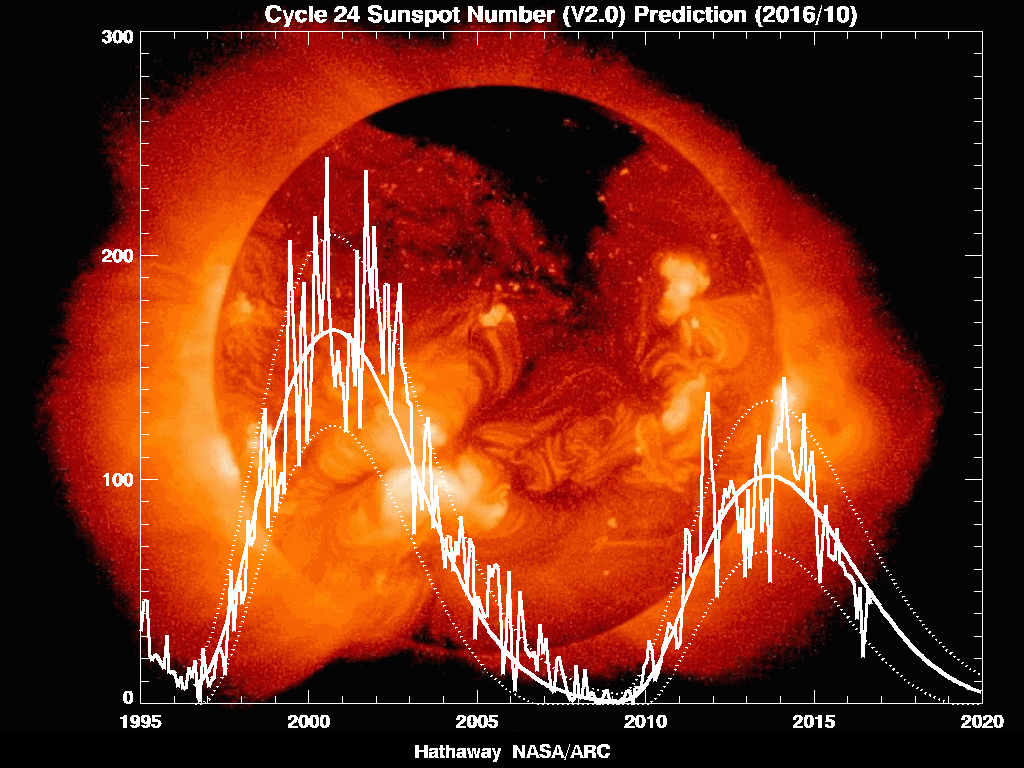
Quiet suns come along every 11 years or so. It's a natural part of the sunspot cycle, discovered by German astronomer Heinrich Schwabe in the mid-1800s. Sunspots are planet-sized islands of magnetism on the surface of the sun; they are sources of solar flares, coronal mass ejections and intense UV radiation. Plotting sunspot counts, Schwabe saw that peaks of solar activity were always followed by valleys of relative calm—a clockwork pattern that has held true for more than 200 years: plot.

The current solar minimum is part of that pattern. In fact, it's right on time. "We're due for a bit of quiet—and here it is," says Pesnell.

But is it supposed to be this quiet? In 2008, the sun set the following records:

A 50-year low in solar wind pressure: Measurements by the Ulysses spacecraft reveal a 20% drop in solar wind pressure since the mid-1990s—the lowest point since such measurements began in the 1960s. The solar wind helps keep galactic cosmic rays out of the inner solar system. With the solar wind flagging, more cosmic rays are permitted to enter, resulting in increased health hazards for astronauts. Weaker solar wind also means fewer geomagnetic storms and auroras on Earth.

A 12-year low in solar "irradiance": Careful measurements by several NASA spacecraft show that the sun's brightness has dropped by 0.02% at visible wavelengths and 6% at extreme UV wavelengths since the solar minimum of 1996. The changes so far are not enough to reverse the course of global warming, but there are some other significant side-effects: Earth's upper atmosphere is heated less by the sun and it is therefore less "puffed up." Satellites in low Earth orbit experience less atmospheric drag, extending their operational lifetimes. Unfortunately, space junk also remains longer in Earth orbit, increasing hazards to spacecraft and satellites.


A 55-year low in solar radio emissions: After World War II, astronomers began keeping records of the sun's brightness at radio wavelengths. Records of 10.7 cm flux extend back all the way to the early 1950s. Radio telescopes are now recording the dimmest "radio sun" since 1955: plot. Some researchers believe that the lessening of radio emissions is an indication of weakness in the sun's global magnetic field. No one is certain, however, because the source of these long-monitored radio emissions is not fully understood.

All these lows have sparked a debate about whether the ongoing minimum is "weird", "extreme" or just an overdue "market correction" following a string of unusually intense solar maxima.

"Since the Space Age began in the 1950s, solar activity has been generally high," notes Hathaway. "Five of the ten most intense solar cycles on record have occurred in the last 50 years. We're just not used to this kind of deep calm."

Deep calm was fairly common a hundred years ago. The solar minima of 1901 and 1913, for instance, were even longer than the one we're experiencing now. To match those minima in terms of depth and longevity, the current minimum will have to last at least another year.


In a way, the calm is exciting, says Pesnell. "For the first time in history, we're getting to see what a deep solar minimum is really like." A fleet of spacecraft including the Solar and Heliospheric Observatory (SOHO), the twin STEREO probes, the five THEMIS probes, Hinode, ACE, Wind, TRACE, AIM, TIMED, Geotail and others are studying the sun and its effects on Earth 24/7 using technology that didn't exist 100 years ago. Their measurements of solar wind, cosmic rays, irradiance and magnetic fields show that solar minimum is much more interesting and profound than anyone expected.

Modern technology cannot, however, predict what comes next. Competing models by dozens of top solar physicists disagree, sometimes sharply, on when this solar minimum will end and how big the next solar maximum will be. Pesnell has surveyed the scientific literature and prepared a "piano plot" showing the range of predictions. The great uncertainty stems from one simple fact: No one fully understands the underlying physics of the sunspot cycle.

Pesnell believes sunspot counts will pick up again soon, "possibly by the end of the year," to be followed by a solar maximum of below-average intensity in 2012 or 2013.

But like other forecasters, he knows he could be wrong. Bull or bear? Stay tuned for updates.