
Wednesday, April 23, 2014
Today's Maneuvers

Monday, April 21, 2014
An Astronomical Picture of SDO

One of the cool things about knowing astronomers is the clever things they do with cameras. Here is one example. William Livingston, a solar astronomer living in Tucson, AZ, has taken pictures of the geostationary satellite ring since about 2001. These satellites tend to be big, and stay in one place over the Earth. By taking a long exposure (here about 9 hours), the satellites are almost points of light while the stars are long trails. (A nine hour star trail would cover 135 degrees of the sky.) Here is an example from March 2014. You can see 40 satellites in the center of the picture, all but one labeled with their name. SDO orbits the Sun every 24 hours, but at an angle to where these satellites orbit. Because it does not hover over the same place on Earth, SDO moves up and down through the geostationary satellites every day. So SDO isn't a point of light, it is another trail moving across the star trails. To help you find it, SDO is labeled on the plot. It is the very faint trail moving downward from between DirecTV 11 and DirecTV 8 to the l in Solar.
Dr. Livingston has been taking these pictures since 2001. I found a link about some of his first pictures. Another link describes the settings for digital cameras if you want to try to take pictures yourself. You'll need a dark sky and a steady mount!
Thanks to Bill for sending me these pictures.
Tuesday, April 8, 2014
HMI Roll Tonight
This data is used to study how the instruments change while they are on orbit. The most important science that comes out is whether the Sun is round or bulges a little bit at the waist. So far, it appears that the Sun bulges less than we expect and that bulge does not change very much as sunspots come and go. The only way to check is to redo the measurements at different times in the solar cycle. This set of points will be made at the maximum of Solar Cycle 24.
Thursday, April 3, 2014
EVE Cruciform on April 2, 2014

Monday, March 31, 2014
X-1 Flare Yesterday with a Nice Coronal Dimming
The X-1 flare on Saturday produced a very nice example of coronal dimming. Here is a short movie showing five hours of the Sun in the AIA 193 passband. After the flare happens in the upper right quadrant at 1755 UTC on March 29, 2014, a dark region spreads over the north pole. This is a coronal dimming event. There are many ways to interpret these dimming events. Are they the edges of the coronal mass ejection that left the Sun at the time of the flare? Are they waves moving past magnetic field lines and making them sway? Whatever it is, it moves fast. Active Region 12017 is at 10°N 48°W. If something moves from there to the north pole of the Sun (90°N) in 45 minutes it had to move at about 360 km/s (800,000 mph). I only see the dimming moving north.
Wherever coronal dimmings come from, they look pretty cool.
Wednesday, March 26, 2014
Momentum Management Maneuver Today
Today at 1840 UTC (2:40 pm ET) SDO will execute a momentum management maneuver. For about 45 minutes from 1815 to 1900 UTC SDO data may be unavailable.
Wednesday, March 12, 2014
SDO on the Astronomy Picture of the Day

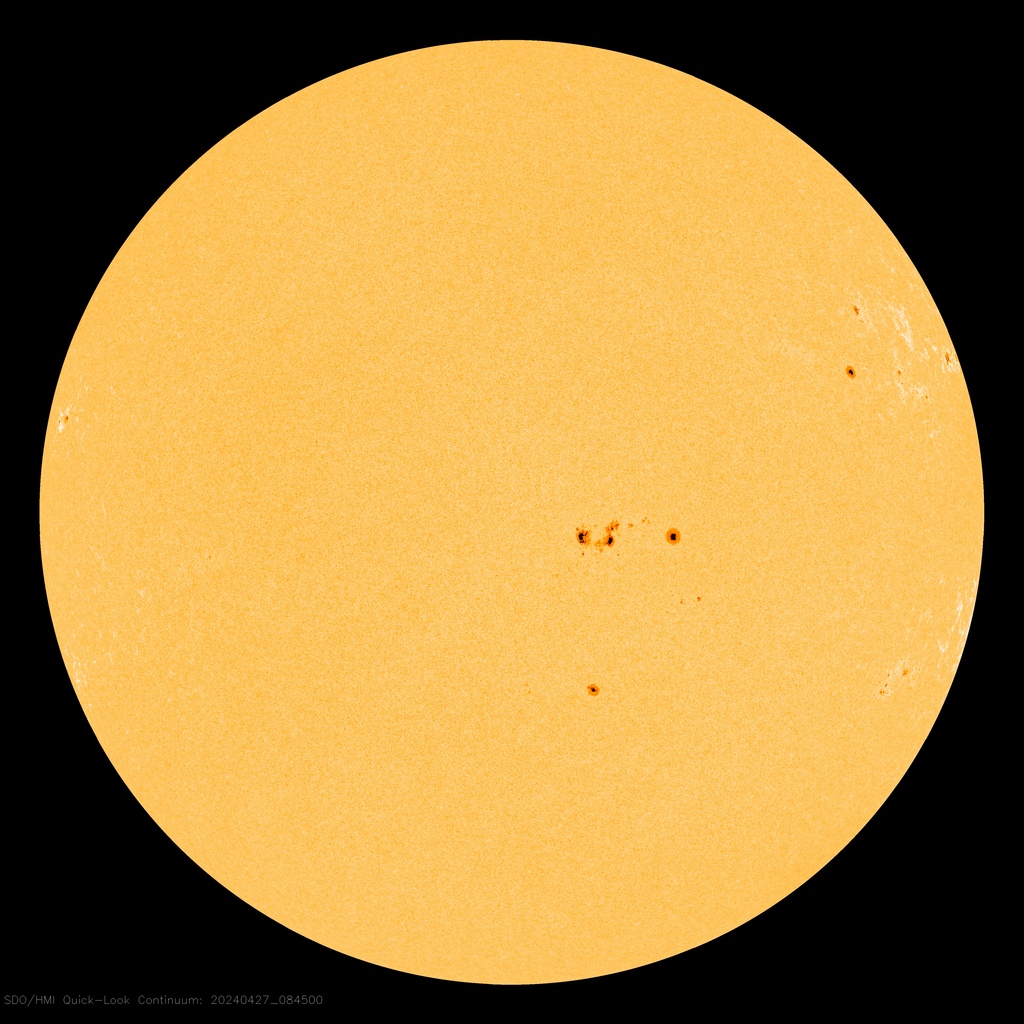
January's 31 days are a little longer than one solar rotation of 27.27 days. That means you see a part of the Sun that is just off limb at the beginning of the month a second time as that part of the Sun rotates back into view. Active region 11944 is present throughout the month in the southern hemisphere and reappears as AR 11967 at the end of the movie. AR 11946 grows in the northern hemisphere and will reappear as AR 11968. AR 11944 will also return as AR 11990 in late February. On February 25 it will be the location of an X-4.9 flare as it rotates back into view.
Long-lived active regions are a sign that solar maximum is here and starting to fade.
Check it out!