
Tuesday, February 16, 2021
Happy 11th Birthday to SDO

Wednesday, March 14, 2018
Happy Pi Day!

Enjoy Π Day!
Thursday, April 28, 2016
April Showers Bring May Scholars
Tim Larson, Stanford University, Global-Mode Helioseismology: Extensions of a Well-Used Method;
Ed Thiemann, University of Colorado, Multi-Spectral Sensor Driven Solar EUV Irradiance Models with Improved Spectro-Temporal Resolution for Space Weather Applications at Earth and Mars;
James Mason, University of Colorado, Solar Eruptive Events: Coronal Dimming and a New Cubist Mission; and
Nishu Karna, George Mason University, A Comprehensive Study of Cavities on the Sun: Structure, Formation, and Evolution.
Congratulations to each new Ph.D. Try to enjoy not being a student!
Thursday, January 1, 2015
A Big SDO Welcome to 2015!

There were no fireworks on the Sun last night to welcome in the New Year. Only a few C-class flares during the last day of 2014. Instead, the Sun starts 2015 with an enormous coronal hole near the South Pole. Here is an AIA 193 Å image from January 1, 2015 showing the coronal hole as a dark region in the south.
Coronal holes are regions of the corona where the magnetic field reaches out into space rather than looping back down onto the surface. Particles moving along those magnetic fields can leave the Sun rather than being trapped near the surface. Those trapped particles can heat up and glow, giving us the lovely AIA images. In the parts of the corona where the particles leave the Sun the glow is much dimmer and the coronal hole looks dark.
Coronal holes were first seen in images taken by astronauts on board NASA’s Skylab space station in 1973 and 1974. They can be seen for a long time, although the exact shape changes all the time. The polar coronal hole can remain visible for five years or longer. Each time a coronal hole rotates by the Earth we can measure the particles flowing out of the hole as a high-speed stream, another source of Space Weather.
Charged particles in the Earth’s radiation belts are accelerated when the high-speed stream runs into the Earth’s magnetosphere. The acceleration of particles in the magnetosphere is studied by NASA’s Van Allen Storm Probe mission.
As Solar Cycle 24 fades, the number of flares each day will get smaller, but the coronal holes provide another source of Space Weather that needs to be understood and predicted.
Happy New Year!
Monday, March 31, 2014
X-1 Flare Yesterday with a Nice Coronal Dimming
The X-1 flare on Saturday produced a very nice example of coronal dimming. Here is a short movie showing five hours of the Sun in the AIA 193 passband. After the flare happens in the upper right quadrant at 1755 UTC on March 29, 2014, a dark region spreads over the north pole. This is a coronal dimming event. There are many ways to interpret these dimming events. Are they the edges of the coronal mass ejection that left the Sun at the time of the flare? Are they waves moving past magnetic field lines and making them sway? Whatever it is, it moves fast. Active Region 12017 is at 10°N 48°W. If something moves from there to the north pole of the Sun (90°N) in 45 minutes it had to move at about 360 km/s (800,000 mph). I only see the dimming moving north.
Wherever coronal dimmings come from, they look pretty cool.
Wednesday, March 12, 2014
SDO on the Astronomy Picture of the Day

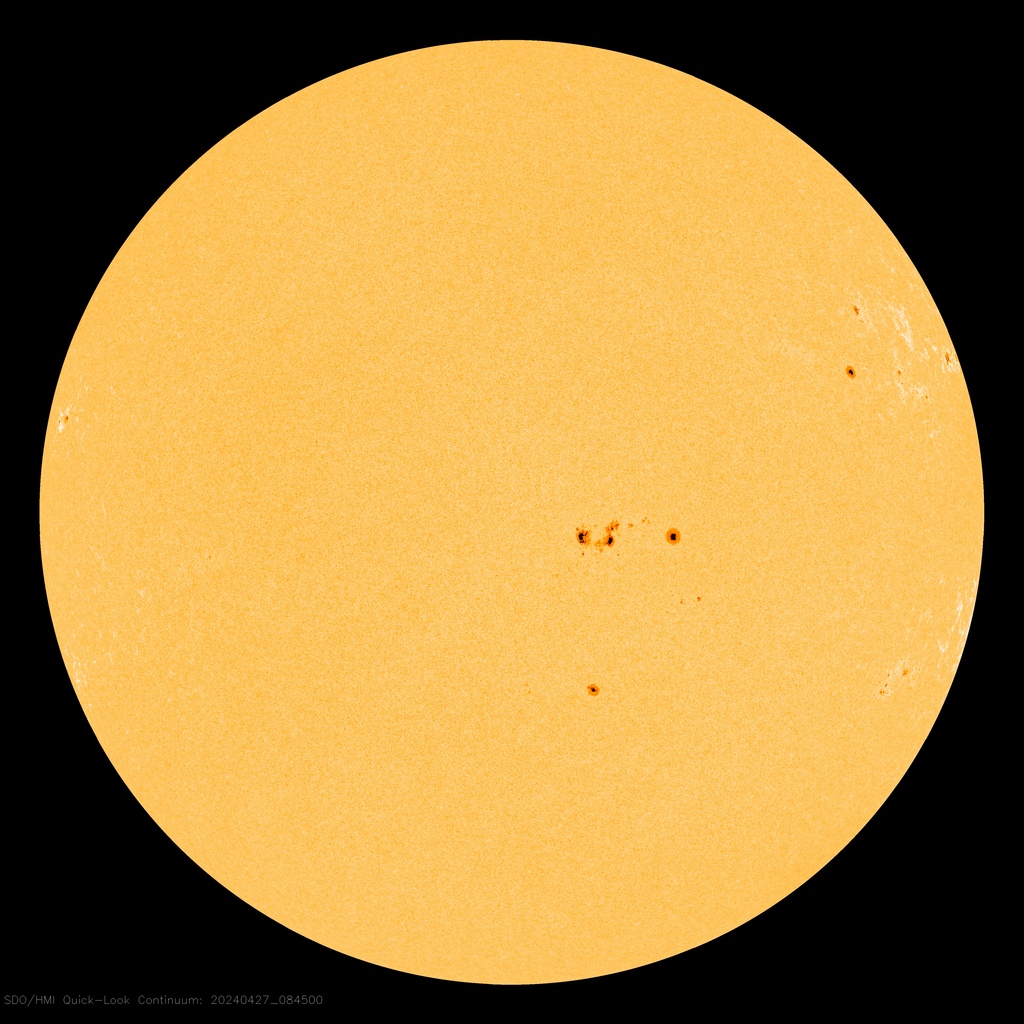
January's 31 days are a little longer than one solar rotation of 27.27 days. That means you see a part of the Sun that is just off limb at the beginning of the month a second time as that part of the Sun rotates back into view. Active region 11944 is present throughout the month in the southern hemisphere and reappears as AR 11967 at the end of the movie. AR 11946 grows in the northern hemisphere and will reappear as AR 11968. AR 11944 will also return as AR 11990 in late February. On February 25 it will be the location of an X-4.9 flare as it rotates back into view.
Long-lived active regions are a sign that solar maximum is here and starting to fade.
Check it out!
Tuesday, February 11, 2014
Four Years of SDO and A New Look for our Website!


Thanks for looking at SDO data and making us a great mission. Here's an AIA 193 image that seems to have the Sun smiling at us as we start our fifth year.
SDO is GO!
Friday, September 6, 2013
Coronal Holes on NPR

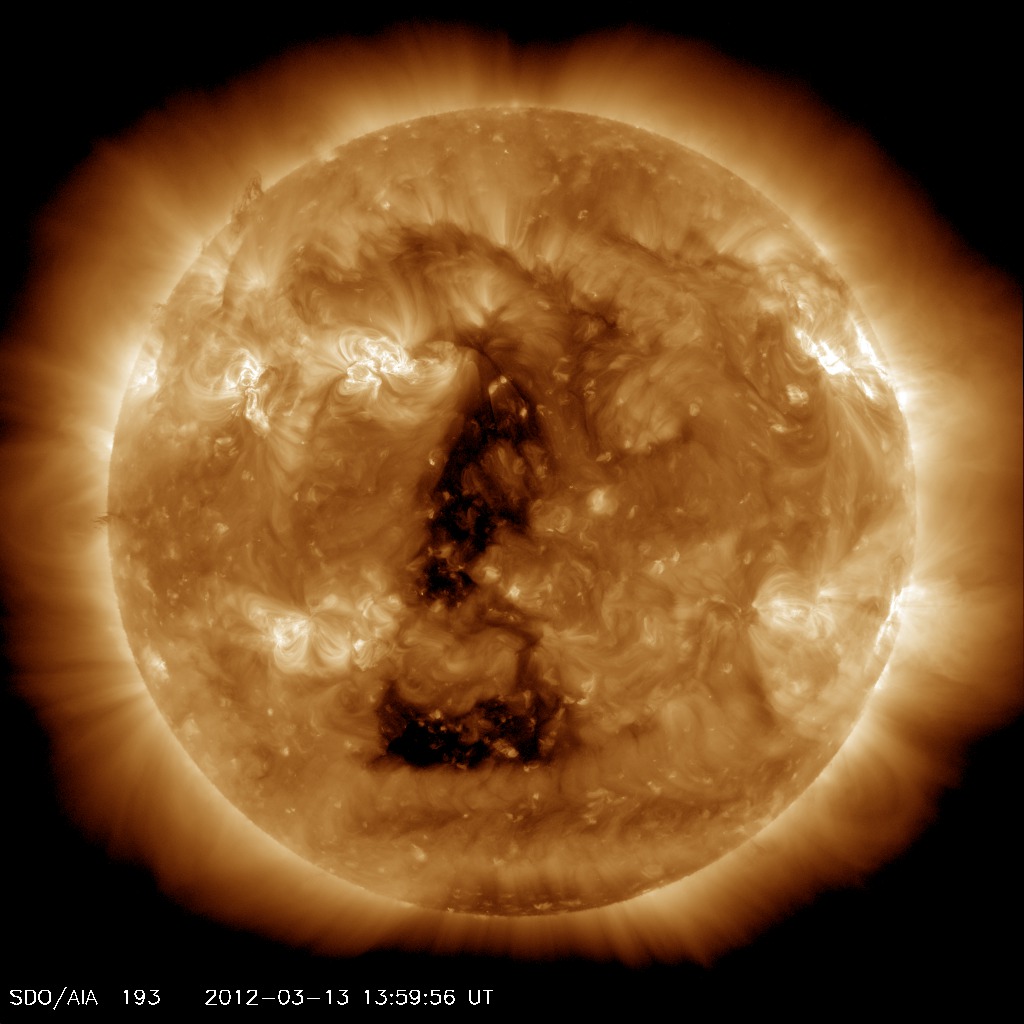

There are other coronal holes in these images. The coronal hole at the south pole of the Sun got smaller going from March to June. These polar coronal holes shrink at solar maximum and then reappear at solar minimum.
Coronal holes, in all of their shapes and sizes, will become more frequent as the Sun starts to reduce solar activity back toward another solar minimum.
Like figures in clouds, these shapes are fun to find. You can look for coronal holes at the SDO data website. They show up best in the 3-color images.
You can read more about coronal holes in another blog post.
Friday, August 16, 2013
Coronal Holes

X-ray images of the Sun often show the large dark regions that we call coronal holes. They may extend from the Sun's equator to its poles, a few from pole to pole. In the 1960's they were seen in X-ray images taken by sounding rockets and detected with some radio telescopes. They were first seen clearly in images taken by astronauts on board the Skylab space station in 1973 and 1974. Waldmeier had seen coronal holes in the 1950’s with a green line (Fe XIV 5303) coronagraph that allows the corona to be seen along the limb of the Sun but the X-ray images of the disk of the Sun really showed what they were.
The solar corona is the outer atmosphere of the sun, extending from the solar "surface" out into space. It is difficult to observe from the ground, being seen only during solar eclipses or with special equipment. A coronal hole is a large region in the corona that has a lower density than its surroundings but with about the same temperature. It really is a hole in the corona! You can see the surface of the Sun, which is dark because it is cool next to the coronal temperatures of several million Kelvin. Although coronal holes can appear at any time of the solar cycle, they are most common and last the longest during the declining phase of the cycle.
The magnetic field in a coronal hole opens to interplanetary space. This is unlike the active Sun where the solar magnetic fields loop back to the Sun’s surface and form the bright loops and arches seen in X-ray and UV images. The rest of the Sun is covered with the quiet Sun magnetic carpet.
During solar minimum the coronal holes near the poles can last for several years. Holes near the equator may open and close in as little as a day but often remain visible for more than a month. Other magnetic features, such as sunspots and filaments, rarely last more than a rotation of the Sun (27 days). This means coronal holes may be the longest lasting magnetic feature on the Sun.
The presence of open magnetic field lines in coronal holes allows the plasma to escape, meaning that coronal holes have a lower density then the surrounding corona. The escaping particles mean that coronal holes are sources of high-speed solar wind streams. Particles in these streams can move at speeds up to 800 km/s (1.8 million mph). When the particles from these streams hit the Earth they may cause geomagnetic storms.
At times of high solar activity, geomagnetic storms are usually caused by coronal mass ejections (CME's) striking the Earth's magnetosphere. During times of low solar activity, coronal holes are the most common source of geomagnetic storms. Because coronal holes can last for many months, it is often possible to predict the occurrence of this type of geomagnetic disturbance, as the high-speed stream sweeps past the Earth with each solar rotation (like a rotating garden sprinkler). It may be possible to predict solar activity by the size of the coronal holes that form over the poles of the Sun.
In the SDO image from August 14, 2013 shown above the bright regions indicate hotter areas of the solar corona, mainly above active regions. A large dark coronal hole extends across the northern hemisphere. The stringy dark areas are filaments, cooler plasma held above the surface of the Sun by magnetic fields.
This picture shows two sources of geomagnetic storms, coronal holes, a source of high-speed streams, and filaments, whose eruption causes coronal mass ejections, in one picture. The filament in the lower right erupted as a coronal mass ejection a few hours after this image was recorded. Aurora caused by the high-speed stream emitted by the coronal hole were seen last night.
Edit 8/19/2013: It was pointed out on Facebook that the leftmost filament is actually another coronal hole.