On Monday around 0500 UTC, SDO pointed toward Regulus, a bright star in Leo. Half of the solar disk was kept on the CCDs and Regulus was to be a rotation indicator, helping us learn the roll angle of SDO around the Sun. Analysis of the data is continuing.
Today at 1920 UTC SDO used its thrusters to dump momentum from its reaction wheels. These wheels keep SDO pointed at the Sun as it orbits the Earth and the high-gain antennas keep turning. All that turning is transfered to the reaction wheels; every so often we have to reduce the wheel spin rates. We used 20 grams of propellant in the maneuver.

Wednesday, August 25, 2010
Tuesday, August 24, 2010
48 Hour MPEGs
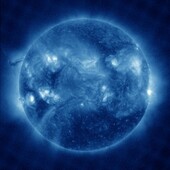 The latest 48 hour mpegs have been released on the website. They are available for all 10 AIA channels.

Sunday, August 22, 2010
AIA and HMI Images Unavailable

At this time we are not receiving images from AIA and HMI. The data is flowing from SDO to the JSOC, but the ground software is not creating the images we display on the SDO website. Some bandpasses are being updated, but most are not.
The problem is being worked and should be fixed soon.
Thursday, August 19, 2010
Scheduled Outage - Friday, August 20, 2010
NOTICE: This website will be down between the evening of Thursday, August 19, 2010, and the afternoon of Friday, August 20, 2010, for scheduled maintenance of the power and cooling systems.
Sunday, August 15, 2010
Another nice eruption

Yesterday morning at around 9:00 UT the Sun erupted with another beautiful coronal mass ejection. The image is from AIA at a wavelength of 211 Angstroms, click the image to see the eruption.
Saturday, August 14, 2010
Another Flare and CME
Active regions 1093 and 1099 erupted with a C-class flare and CME this morning at about 1000 UT. Here is a movie produced at LMSAL AIA showing the 193 bandpass of AIA. It looks pretty good in the various bandpasses in the Browse Data movies on this website.
Friday, August 13, 2010
Everything running normally
The SDO team works hard to keep the images and data flowing to this and other websites. Software is needed to move and analyze the images; sometimes that software breaks. Hardware is needed to host and serve the images; sometimes we lose power to a computer. We have experienced several outages the last two weeks during which the images were not available. After the outages were fixed, software was written to reconstruct the images missing from this website from the JSOC in California. We are also working to make the system more robust.
My thanks to the people who keep the data flowing.
Today we have all the images flowing correctly and the movies working. Check out a day's worth of Dopplergrams. Or what happened at about 0600 UTC this morning.


These images in 171 (left) and 304 (right) show a very nice filament eruption in the lower right limb of the Sun. The 304 bandpass is cooler material and we often see eruptions in that channel. The 171 bandpass is hotter material (about 1 million K) and is less common in the erupting material. You can see the plasma in motion by looking at the daily movies for August 13 or through our Browse Data page.
Subscribe to:
Posts (Atom)