

Thursday, June 23, 2022
Power Still Out at Stanford
The power is still out at the Stanford University building that houses the AIA/HMI JSOC. AIA and HMI data will be unavailable until power is restored. This outage is apparently due to a wildfire near Palo Alo, CA, that brought down the main power lines into the area. The downlinked data is being stored at SDO's White Sands ground station. Once power is restored that data will be transmitted to the JSOC and made available for study. EVE data is still available at the EVE SOC.

Wednesday, June 22, 2022
Data Outage
HMI and AIA data are temporarily unavailable. A widespread power outage has closed the Stanford campus that hosts the SDO Data Center.
Wednesday, May 11, 2022
HMI as a Hi-Speed Coronagraph (updated)
The time in the header of the HMI movie turns out to be off by 3 hours (the movie runs from 1320-1342 UTC). Once I heard that, it was back to Helioviewer (https://www.Helioviewer.org, which now redirects to a GSFC website) to produce an AIA 221 Å movie. I selected the area around the flare and made a movie that covers between 1300 and 1400 UTC. Now there is good agreement in the presence and shape of the filament, even the change from upright oval to a more horizontal appearance. You can compare the movies yourself to see how well the HMI filament tracks the AIA 221 Å filament. The post-flare arcade is much easier to see in this movie.


You are right if you are thinking HMI was lucky. Here is an AIA 304 image of the same region from 1619 UTC of May 3, 2022. The large number of coronal loops makes it very difficult to track the filament seen in the HMI movie.The AIA 304 Å images at the corrected times are saturated and need more analysis to see the filament.
I also looked at the AIA 1600 Å passband and see a beautiful filament at 13:23:50 UTC. The filament is bright because it reflects light from the Sun towards SDO and emits its own light. Use Helioviewer to create your own movie of this passband to see the rest of the flare and filament liftoff.

Solar Cycle 25 is getting interesting!
A magnetic complex, destined to become Active Region 3006, was rotating into view on May 3, 2022, when it was the site of an X1.1 flare at 1309 UTC. Three hours later HMI observed a filament liftoff.
Junwei Zhao used all of the HMI frames to produce this movie of a filament liftoff and other evolution of the solar atmopshere above the nascent AR 3006.
This movie was made by using all of HMI’s 6 line-position intensities — not just the continuum images. Thus, this movie has an amazing 7.5-sec cadence, showing many more details than a 45-sec cadence movie. Because the data is from above the limb, Fe I 6173 is no longer an absorption line, we mostly see how it scatters light from the solar surface towards SDO. (The same is true when you look at filaments in Hα. The filaments are dark against the disk but are seen as bright prominences above the limb.) In this movie the on-disk signal is completely saturated so that the off-limb signal is more easily seen. This movie is also showing a reverse image of the off-limb pixels. The dark material would be bright in the original images. The images are 150" squares. The Sun is 1904" across on May 3, so the area seen in the movie is only 0.6% of the Sun's area.The movie clearly shows material being ejected from the Sun. Some material falls back towards the surface, but then stopped falling and was held there for a few minutes before the light faded away.
Another interesting thing is that a post-flare arcade formed right beside the limb. Although it is small and remains close to the limb, it was undoubtedly there for a few minutes.
This is the fourth off-limb flare captured by the HMI. The first three resulted in quite a few publications in studying the polarization of the off-limb flare loops, the emission mechanisms of the off-limb white flares, and studies coupling the white-light and UV/EUV/X-ray observations. This high-cadence movie shows that we still haven't figured out all of the ways SDO data can be used to study the Sun.

Thanks to Todd Hoeksema, Sushant Mahajan, and Junwei Zhao, all members of the HMI Team at Stanford, for discovering and providing the movies of this limb flare and filament liftoff.
I hope you enjoy this movie.
Thursday, April 7, 2022
April Calibration Maneuvers
SDO will execute several calibration maneuvers during April.
- April 13, 2022: EVE Field of View (1415-1700 UTC, 10:15 am - 1:00 pm ET) and HMI/AIA Flatfield maneuvers (1730-2010 UTC, 1:30-4:10 pm ET)
- April 20, 2022: HMI Roll Maneuver (1400-2040 UTC, 10:00 am - 4:40 pm ET)
- April 27, 2022: EVE Cruciform (1300-1755 UTC, 9:00 am - 1:55 pm ET)
Wednesday, April 6, 2022
Momentum Management Maneuver (Delta-H) #43 Today
SDO will execute Momentum Management Maneuver (Delta-H) #43 today. Between 1830 UTC (2:30 pm ET) and 1915 UTC (3:15 pm) SDO science data may be missing or blurred.
Thursday, March 31, 2022
An X1.3 Flare and a Cool View of Plasma Leaving the Sun
On March 30, 2022, active region 12975 was the site of an X1.3 flare. Here is the daily movie in AIA 171 from that day. AR 12975 is in the upper right quadrant to the right of the far more impressive looking coronal loops above AR 12976.
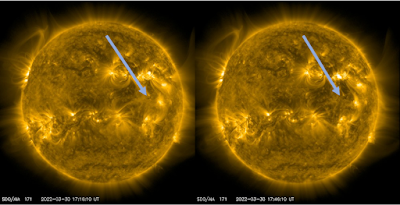 On the left the arrow points at some haze in the AIA 171 image. In the right image the arrow points at about the same place (there is a bright streak just to the right to get you oriented), but the image is less hazy where plasma has left the Sun.
During the day we adjusted the fine guidance telescope, which causes the images to bounce a little bit. The flare starts at 17:26 UTC and ends at 17:46 UTC. What I found cool about this flare was the lass of plasma just south of the flare site. Here are two stills from the movie.

The material that left the Sun isn't all that close to the flare. But you can see in the movie that the haze goes away just after the flare. Look at the movie a few times and you will see the haze disappear.
There is also an excellent coronal cavity display at about 4 o'clock on the limb. These cavities are usually much slower in their evolution.
It is already a great Solar Cycle!
Wednesday, March 2, 2022
Computational Modeling for 3D Data Reconstruction of Solar Coronal Magnetic Fields
Nat Mathews / NASA GSFC
March 2, 2022, 3:30pm Eastern US Time
Abstract: The solar corona supports a variety of magnetic structures that constitute major drivers of space weather. Such a rope of magnetic field can twist and break to launch the plasma locked inside it in a Coronal Mass Ejection. The analysis and prediction of events of this nature is a major goal of the heliophysics community, and reconstructing the current state of the coronal magnetic field is a central component.
Determining the shape and structure of the magnetic fields arcing through the solar corona is a form of nonlinear inverse problem. The goal of this work is to provide a solid foundation for the construction of coronal inversion frameworks. First, a full working version of such an inverse framework is presented. For a variety of reasons, the parameterized forward model is deemed the component of this full inverse model most needing improvement. Subsequent work lays out a brand new methodology for computation of the forward model. The result is a construction that addresses many of the traditional issues around coronal field modeling. Future work extending the approach with Physics-Informed Neural Nets is discussed.</p>
Bio: Nat Mathews recently completed their PhD in applied mathematics with a focus on coronal physics at CU Boulder, advised by Natasha Flyer and Sarah Gibson. They are now a postdoctoral fellow at NASA Goddard.
Subscribe to:
Posts (Atom)