By Laura Layton
Hot on the heels of the official commissioning of the Solar Dynamics Observatory (SDO), on May 17 at Goddard, the spacecraft has begun its science mission and is sending terabytes of data and stunning images to Earth each day.
SDO's images are revealing surprising new insights about how changes on the Sun affect us here on Earth, so it should come as no surprise that public and media interest in the SDO mission has been running at a fever pitch. Most recently, the SDO mission was featured at the 216th meeting of the American Astronomical Society (AAS) and the 2010 Solar Physics Division (SPD) Meeting, held jointly from May 23-27 in Miami, Fla. A number of SDO-related events took place that highlighted the mission’s first science results. Several education and outreach events also took place in conjunction with the meeting.
To read the rest of this article:
Goddard View Volume 6, Issue 5, Page 9

Monday, July 12, 2010
SDO Captures Arcing Active Solar Region in Profile
 As the arcing loops above an active region began to rotate into a nice profile view, SDO captured the dynamic, magnetic struggles taking place below (July 6-8, 2010). Particles spiraling along magnetic field lines trace their paths. Magnetic forces in the active region are connecting, breaking apart, and reconnecting. These images were taken in extreme ultraviolet light. Although mostly hidden from our view, the active region did unleash a number of small flares. Credit: NASA/Goddard/SDO.
- Update
- Here are some articles on the web about this active region
- http://www.msnbc.msn.com/id/38213297/ns/technology_and_science-space/
- http://www.upi.com/Science_News/2010/07/12/Spacecraft-captures-photos-of-sun-activity/UPI-98681278981843/

Thursday, July 8, 2010
Check Out Our Images!
Now that the AIA and HMI data are flowing through the data system, you can look at images of the Sun and make movies of the Sun. Check out the SDO Browser at http://sdo.gsfc.nasa.gov/data/aiahmi/browse.php!
You can look at AIA images after May 20, 2010 and HMI magnetograms created after June 20, 2010. We are working to put the EVE SAM images we show on the Sun Now page into the movie database. Check out the enormous coronal hole in the northern hemisphere seen last week in AIA 193.
Enjoy!
Monday, July 5, 2010
SDO on Science Friday
SDO was featured in a video on NPR's Science Friday website (www.ScienceFriday.com). We described the Sun's magnetic field, the rise to Solar Cycle 24, and how SDO will help to understand the magnetic field. David Hathaway of NASA Marshall Space Flight Center was the guest on the show, discussing solar activity.
» Read the NPR Article.
Wednesday, June 23, 2010
STEREO 3D Sun maps now using SDO data
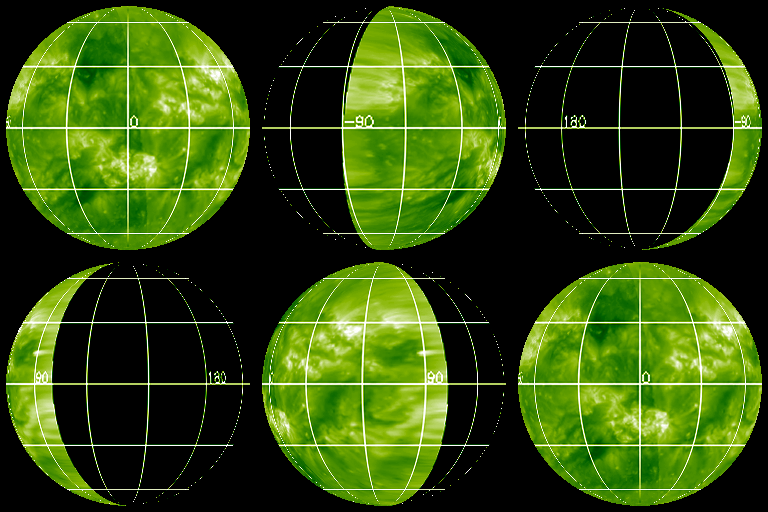

As the two STEREO spacecraft continue their journey along Earth's orbital path, one 70 degrees ahead of Earth and one 70 degrees behind, they have reached the point where they can almost see the Sun on the opposite side of Earth. The maps and movies are now using SDO data to complete the picture. http://stereo-ssc.nascom.nasa.gov/beacon/beacon_secchi.shtml

Tuesday, June 22, 2010
EVE Data Release
The Version 1 official calibrated products are now available effective June 18, 2010. We currently support only expert access directly to the files. A graphical tool that supports searching will soon be available. EVE has been making solar measurements since March 26, 2010. Normal operations began on May 1, 2010.
The ESP Level 1 irradiance data are fully calibrated and corrected for particle background, visible light leakage, degradation in sensitivity, and spacecraft location (corrected to 1‐AU).
A suborbital sounding rocket payload is flown once a year for EVE absolute calibrations. The first suborbital flight after the launch of SDO was on May 3, 2010. Daily on‐orbit calibrations are performed to track changes in detector dark current, filter condition, and electrometer gain.
Each data file covers a time span of 24 hours with 4 measurement/sec cadence. Level 1 data is available with 1 day latency.
There are 2 types of EVE level 2 products: Spectra (EVS) and Lines (EVL). Level 2 spectra are the merged spectral measurements from the two spectrographs, A and B. The A detector is designed to measure from 6‐17 nm, and 16‐38 nm using two filters, while the B detector is designed to measure 35‐105 nm. Level 2 processing stitches these pieces to form one spectrum.
Lines are integrated from low to high bounds, and the 4 Hz photometer data are averaged down to the same time scale as the spectrum. No continuum is subtracted from the line irradiances.
Level 1 Product Overview:
The ESP Level 1 irradiance data are fully calibrated and corrected for particle background, visible light leakage, degradation in sensitivity, and spacecraft location (corrected to 1‐AU).
A suborbital sounding rocket payload is flown once a year for EVE absolute calibrations. The first suborbital flight after the launch of SDO was on May 3, 2010. Daily on‐orbit calibrations are performed to track changes in detector dark current, filter condition, and electrometer gain.
Each data file covers a time span of 24 hours with 4 measurement/sec cadence. Level 1 data is available with 1 day latency.
Level 2 Product Overview:
There are 2 types of EVE level 2 products: Spectra (EVS) and Lines (EVL). Level 2 spectra are the merged spectral measurements from the two spectrographs, A and B. The A detector is designed to measure from 6‐17 nm, and 16‐38 nm using two filters, while the B detector is designed to measure 35‐105 nm. Level 2 processing stitches these pieces to form one spectrum.
Lines are integrated from low to high bounds, and the 4 Hz photometer data are averaged down to the same time scale as the spectrum. No continuum is subtracted from the line irradiances.
Thursday, June 3, 2010
Try Our New Data Browser
We have released the SDO data browser. It allows you to look at movies and still images of the AIA 15-minute cadence data since May 20, 2010.
The features include:
- still images
- movies (as a slide show)
- zip archive download
The web address is: http://sdo.gsfc.nasa.gov/data/aiahmi/browse.php
Subscribe to:
Posts (Atom)